Charts
Uganda’s key numbers, one chart each. Share them, download the data, or dig deeper.
Economy
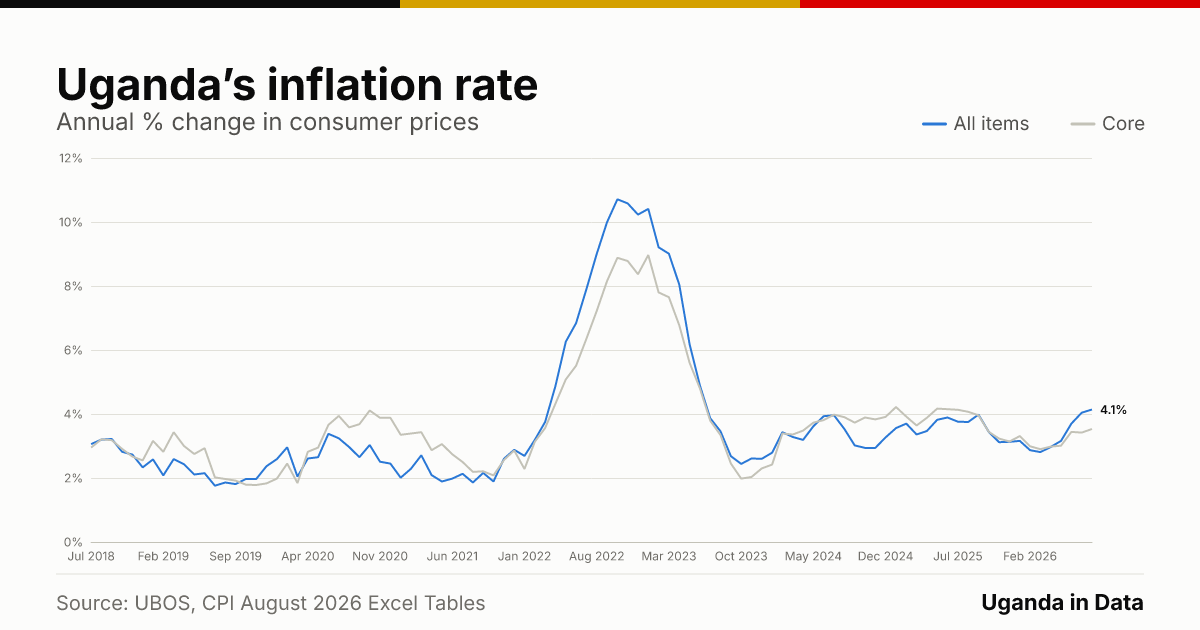 Uganda’s inflation ratePrices were 4.1% higher in August 2026 than a year earlier. Inflation peaked at 10.7% in October 2022.
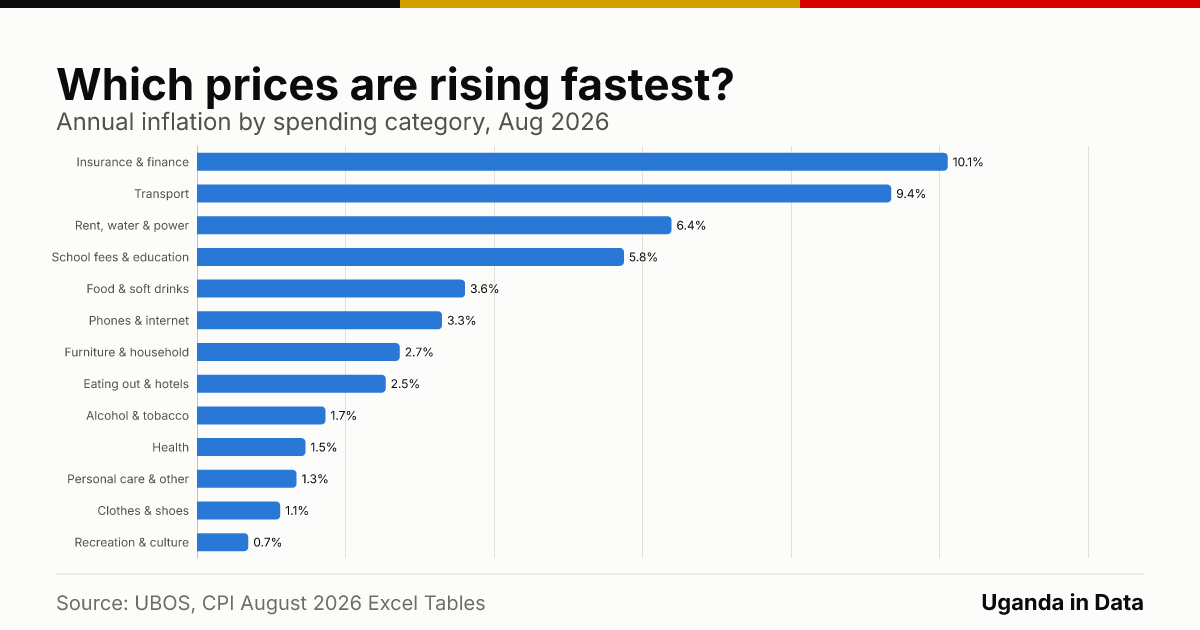 Which prices are rising fastest?Insurance & finance is rising fastest at 10.1% a year; Recreation & culture slowest at 0.7%.
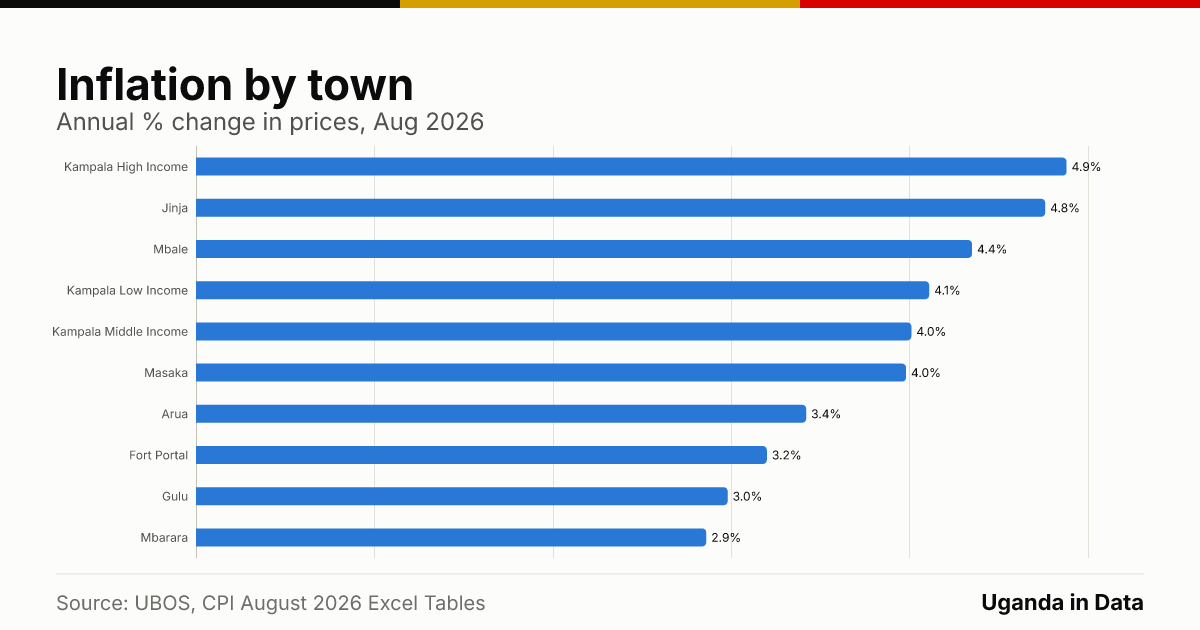 Inflation by townPrices rose fastest in Kampala High Income (4.9%) and slowest in Mbarara (2.9%).
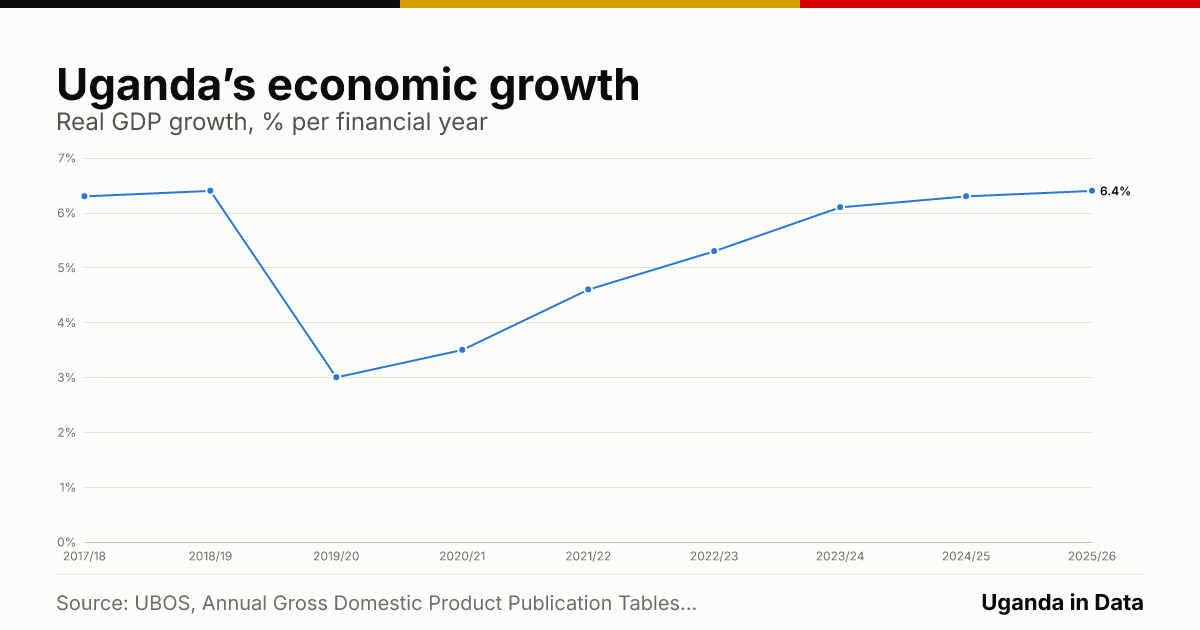 Uganda’s economic growthThe economy grew 6.4% in 2025/26 after prices are taken out.
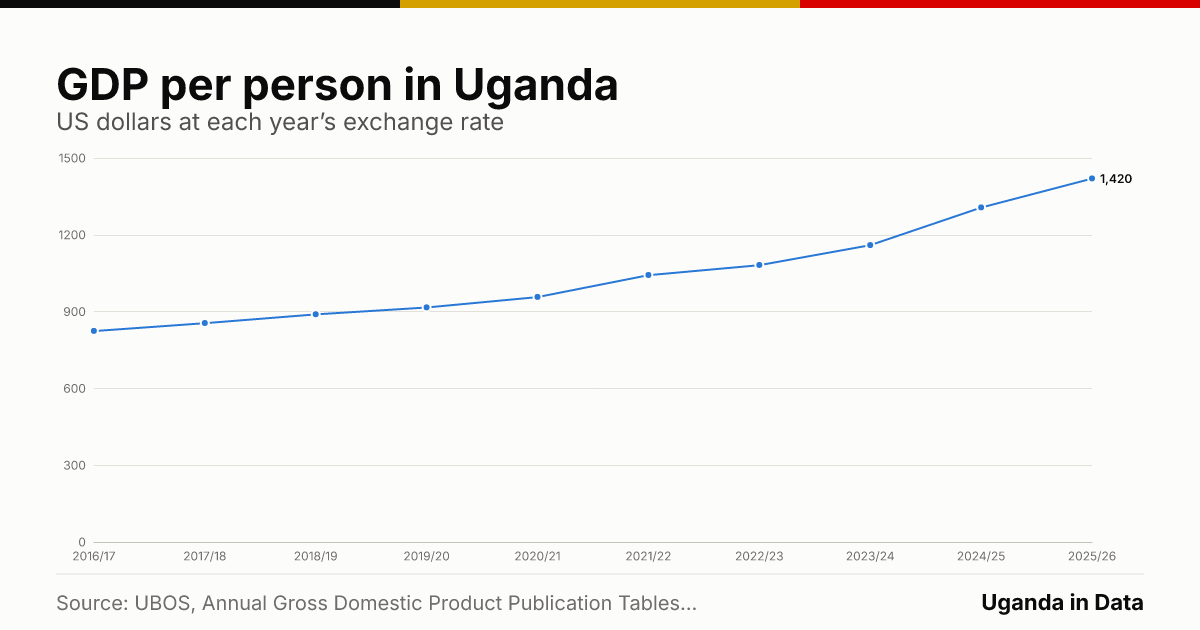 GDP per person in UgandaGDP per person was US$1,420 in 2025/26, up from US$824 in 2016/17.
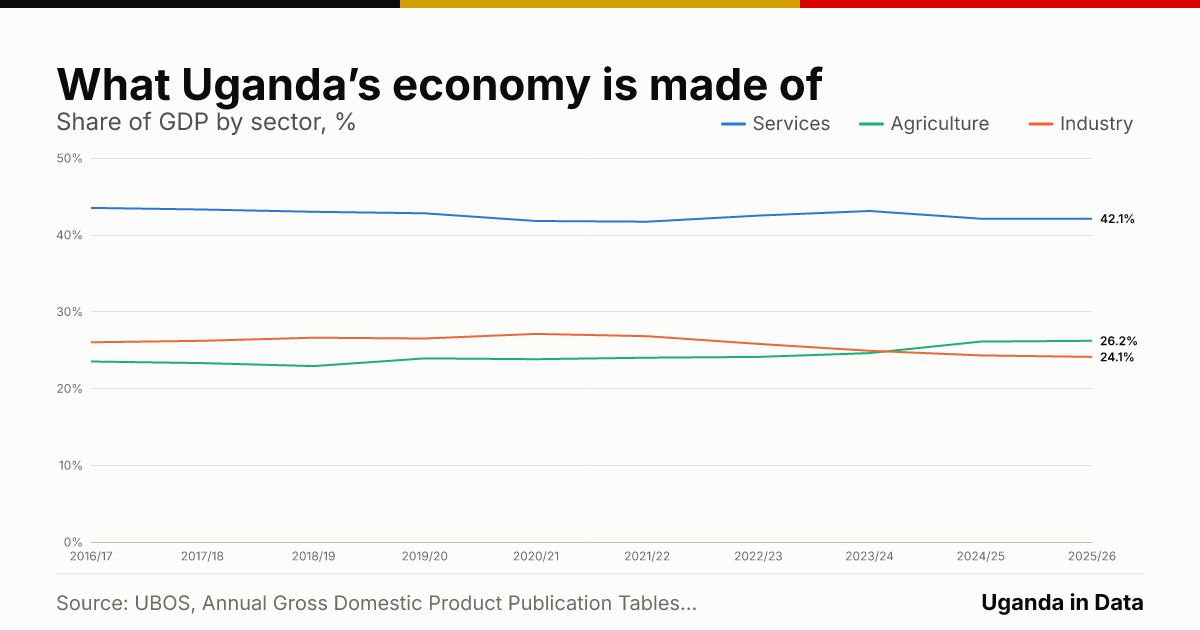 What Uganda’s economy is made ofIn 2025/26, services were 42.1% of GDP, agriculture 26.2% and industry 24.1%.
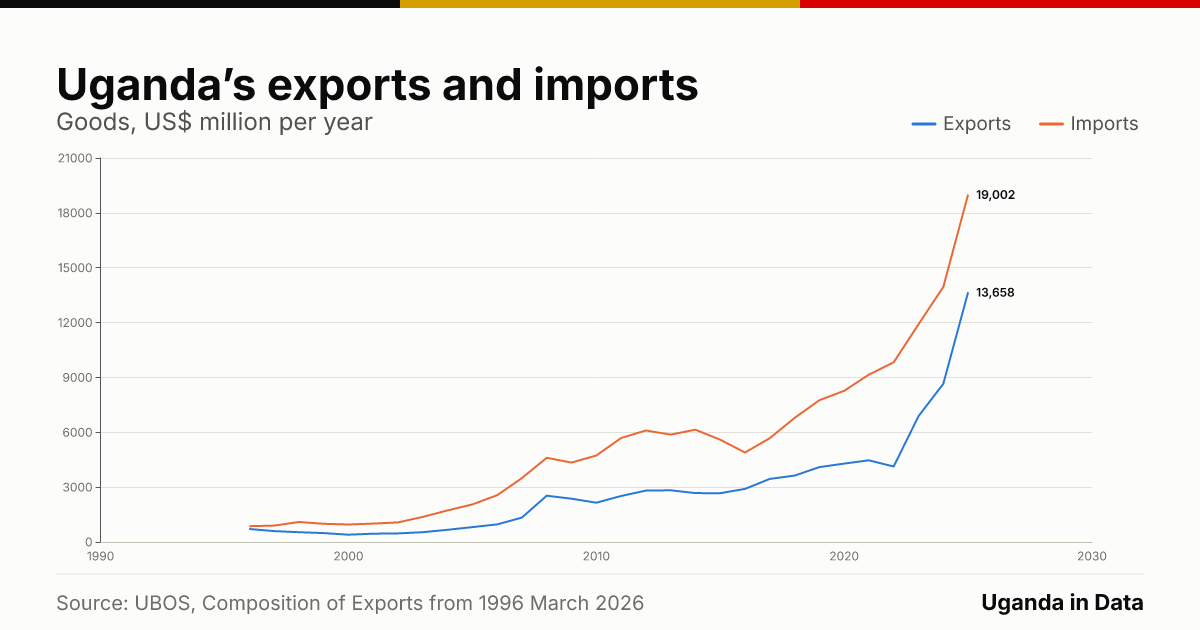 Uganda’s exports and importsUganda exported US$13.7 billion and imported US$19.0 billion of goods in 2025. Gold was 47% of exports.
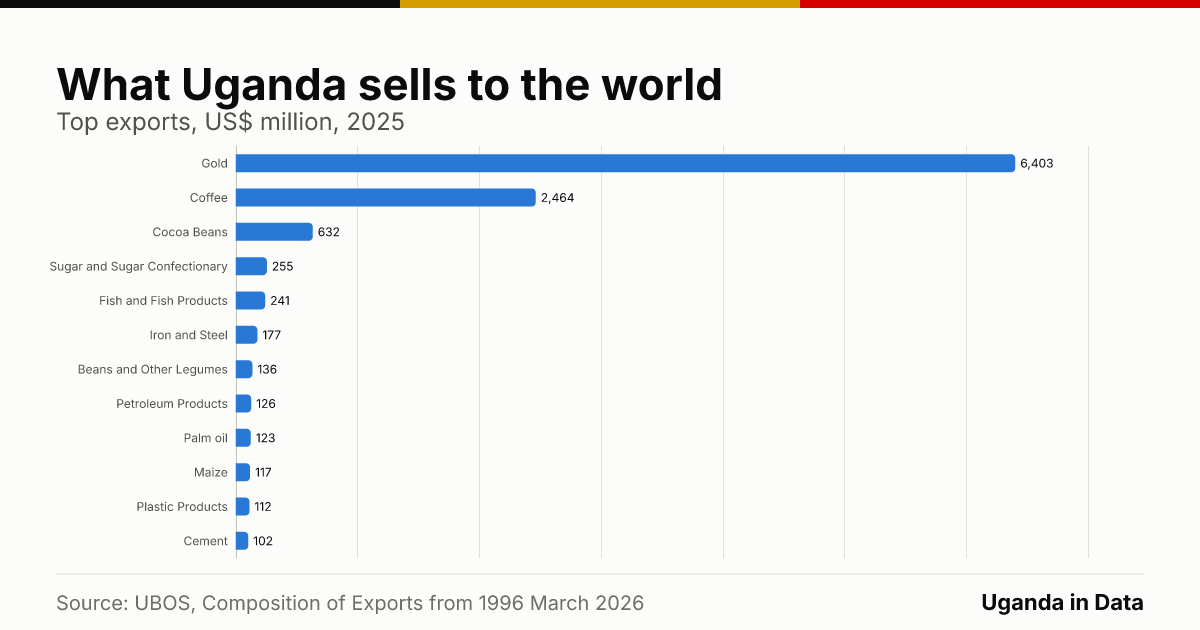 What Uganda sells to the worldGold (US$6.4 billion) and coffee (US$2.46 billion) lead Uganda’s exports.
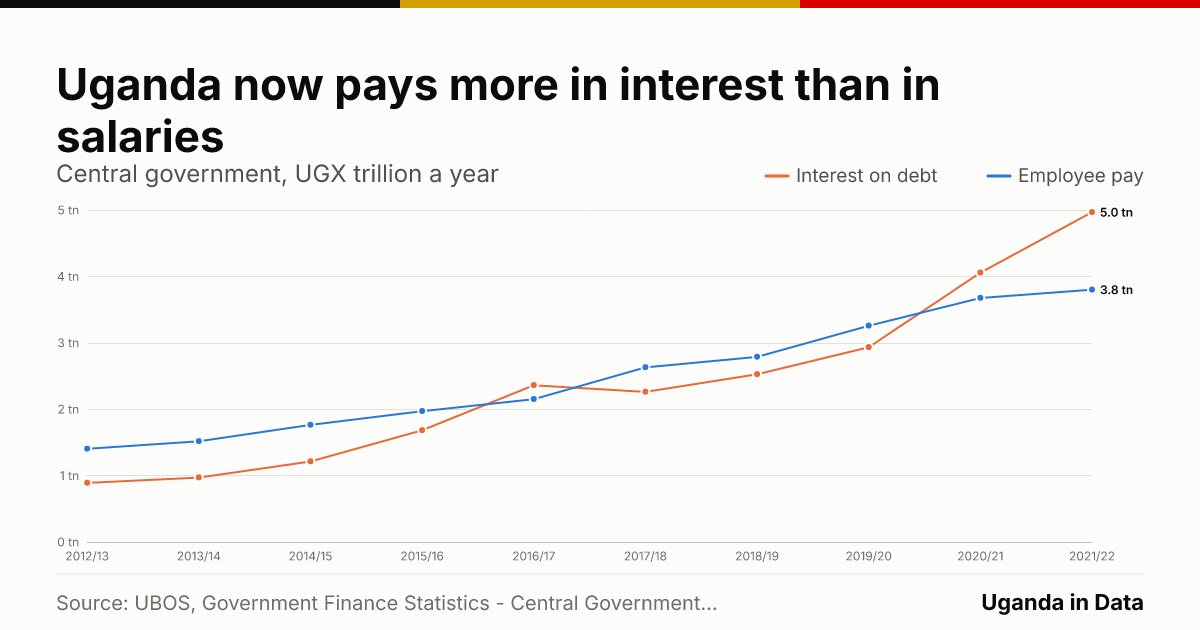 Uganda now pays more in interest than in salariesInterest on government debt rose from UGX 0.9 trillion in 2012/13 to UGX 5.0 trillion in 2021/22, 5.6 times as much. By 2021/22 central government spent more on interest (UGX 5.0 trillion) than on paying all its employees (UGX 3.8 trillion).
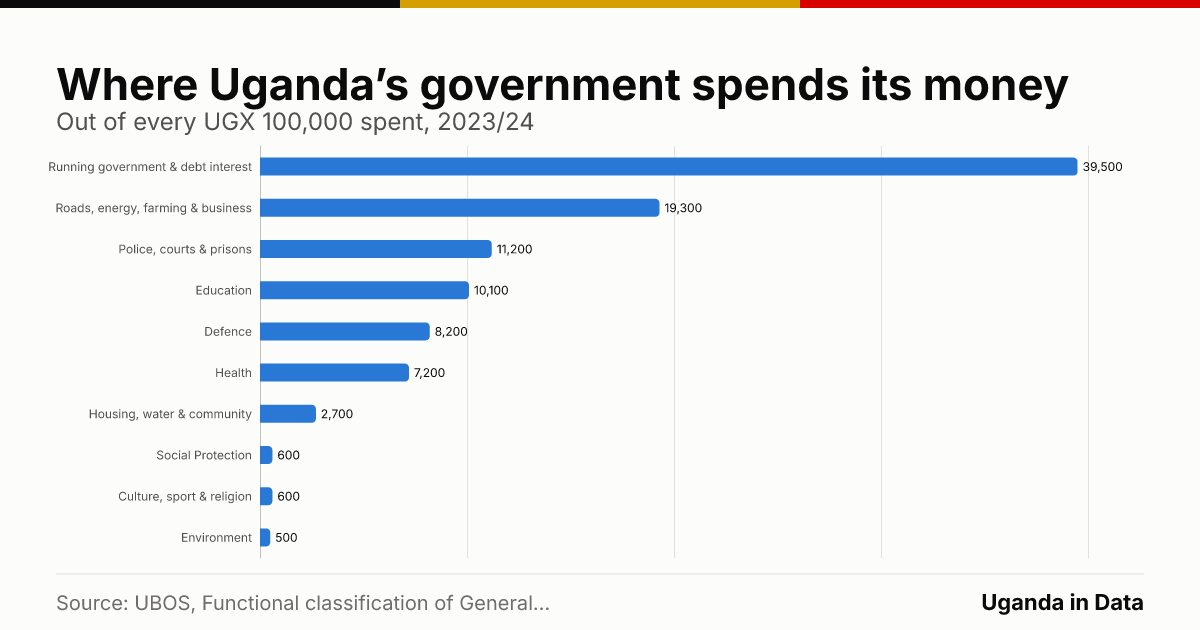 Where Uganda’s government spends its moneyGovernment spent UGX 38.3 trillion in 2023/24. Education got UGX 10,100 and health UGX 7,200 of every UGX 100,000.
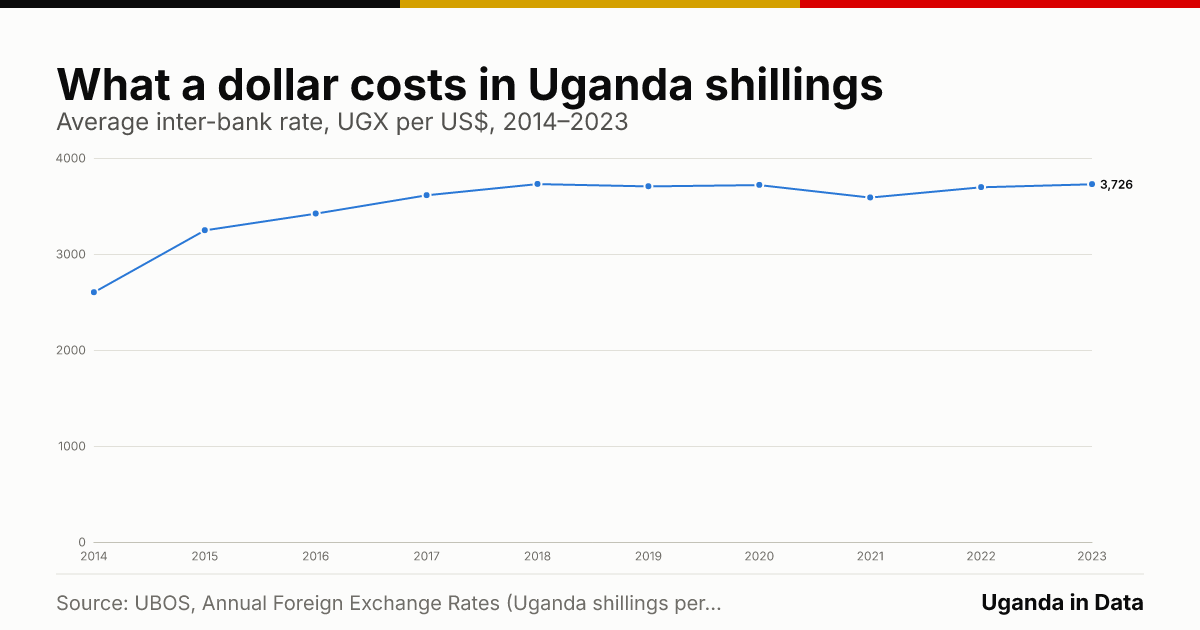 What a dollar costs in Uganda shillingsA US dollar cost about UGX 2,600 in 2014 and UGX 3,726 in 2023: 43% more shillings.
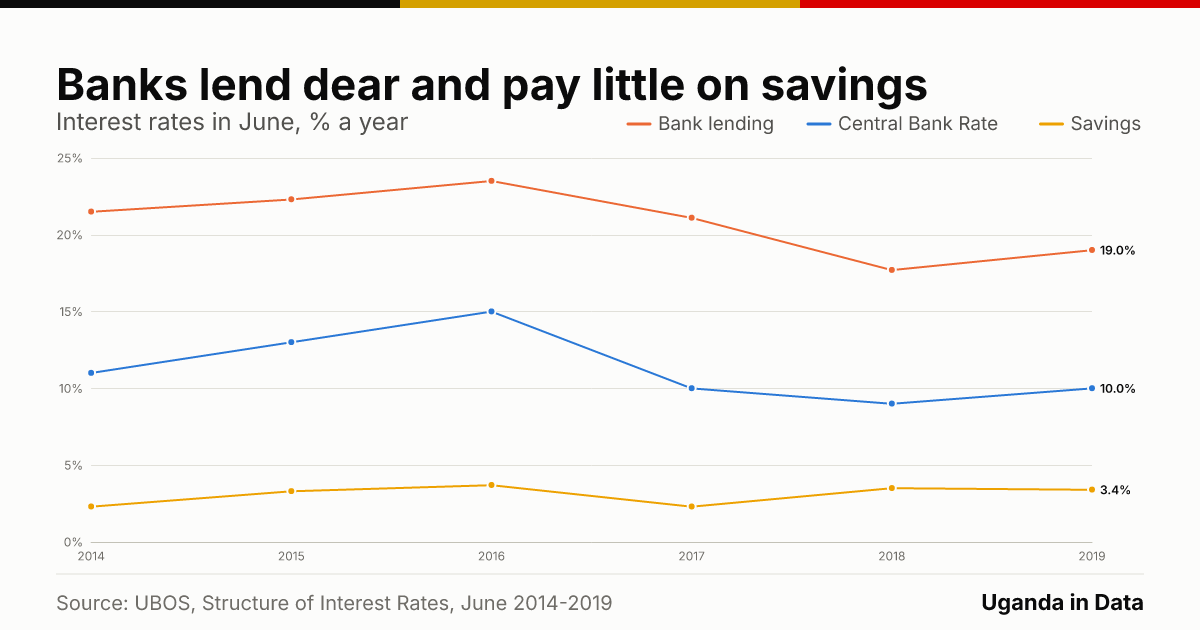 Banks lend dear and pay little on savingsIn June 2019, banks charged 19.0% a year on shilling loans on average, but paid only 3.4% on savings accounts.
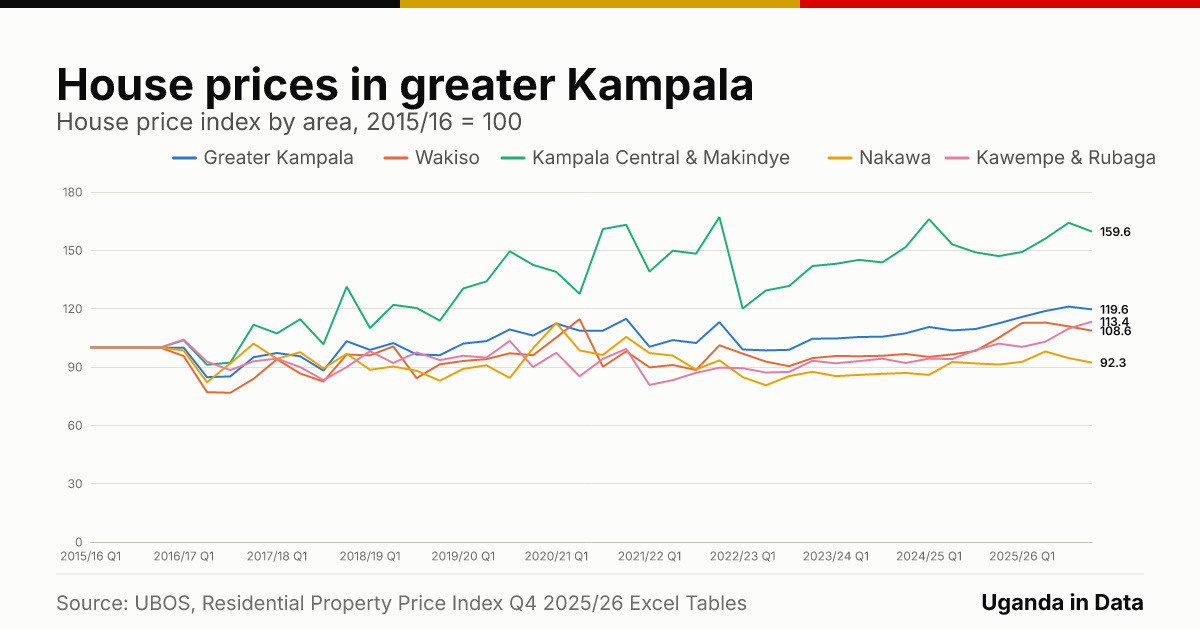 House prices in greater KampalaHouse prices in greater Kampala rose 6.4% in the year to 2025/26 Q4. Since 2015/16, prices are 20% higher overall, but it depends where: Kampala Central & Makindye is up 60%, while Nakawa is still 8% lower.
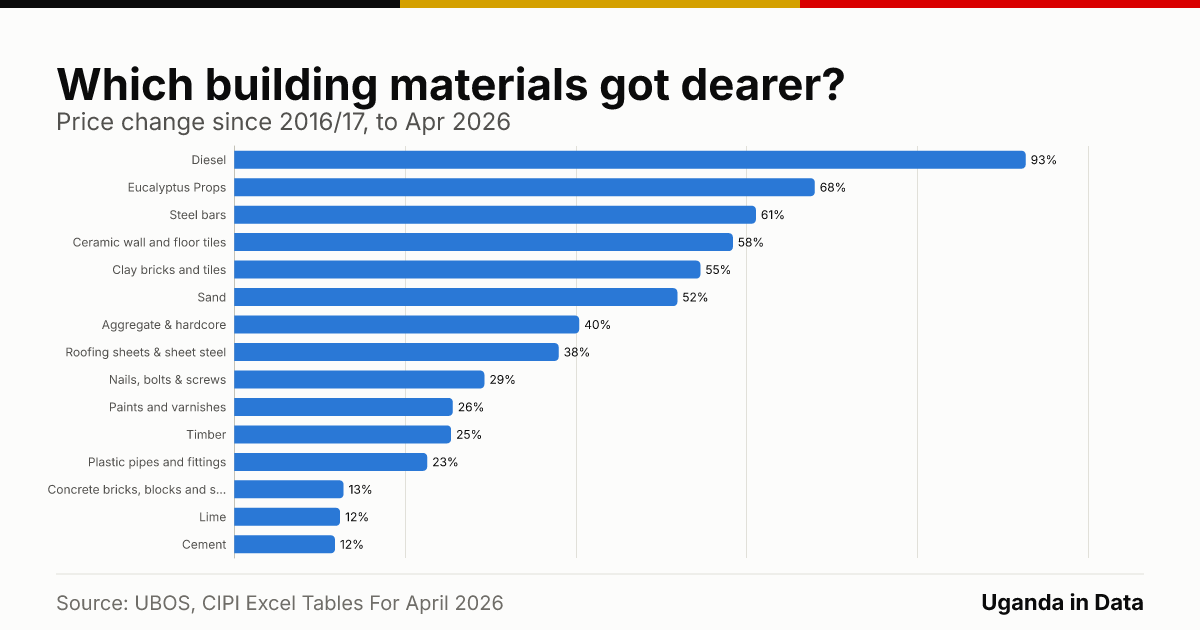 Which building materials got dearer?Building materials, labour and services together cost 1.6% more than a year earlier (April 2026). Since 2016/17, construction costs are up 30%. Diesel rose most (+93%); cement only +12%.
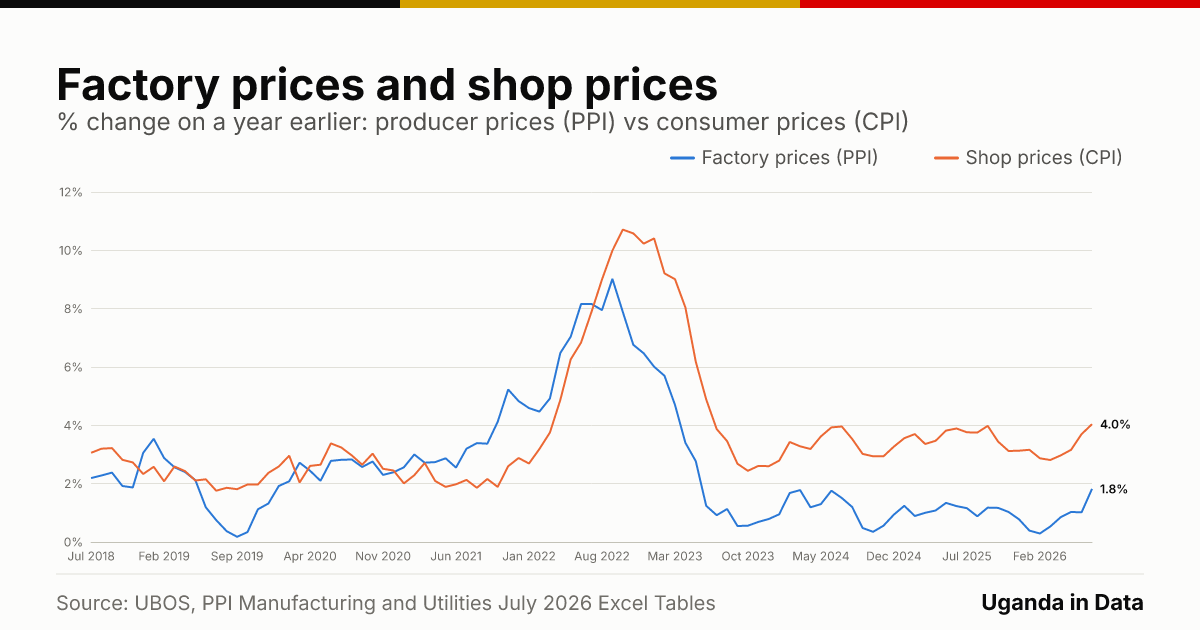 Factory prices and shop pricesPrices charged by Uganda’s factories and utilities rose 1.8% in the year to July 2026. Shop prices (the CPI) rose 4.0% over the same year.
People
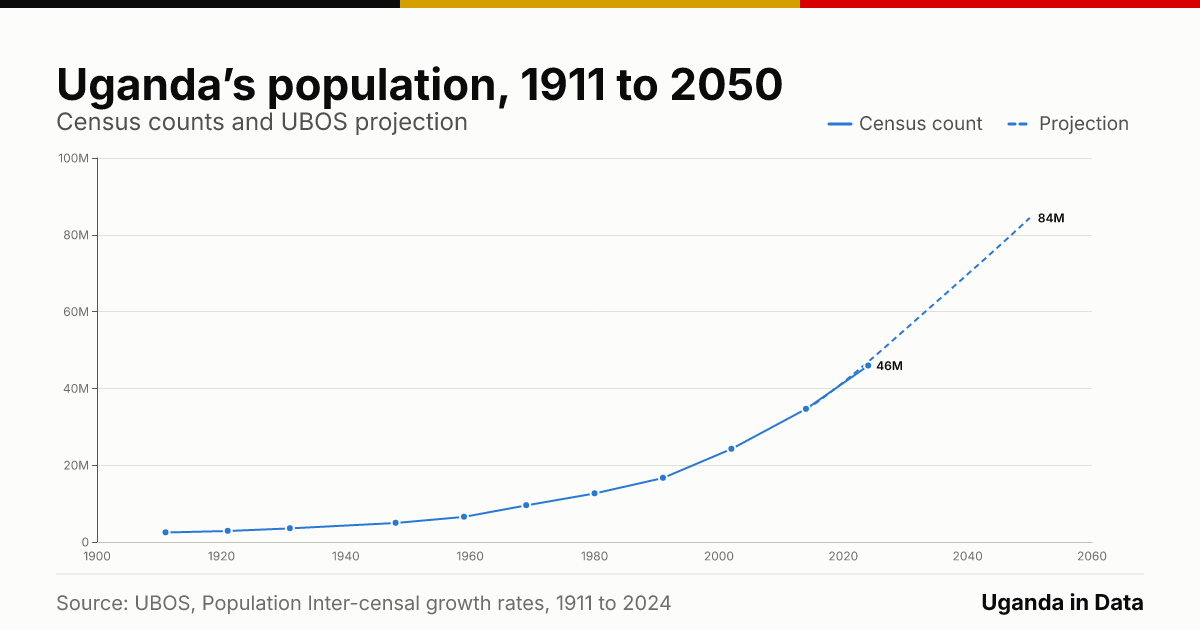 Uganda’s population, 1911 to 2050The 2024 census counted 45.9 million people. UBOS projects 84 million by 2050.
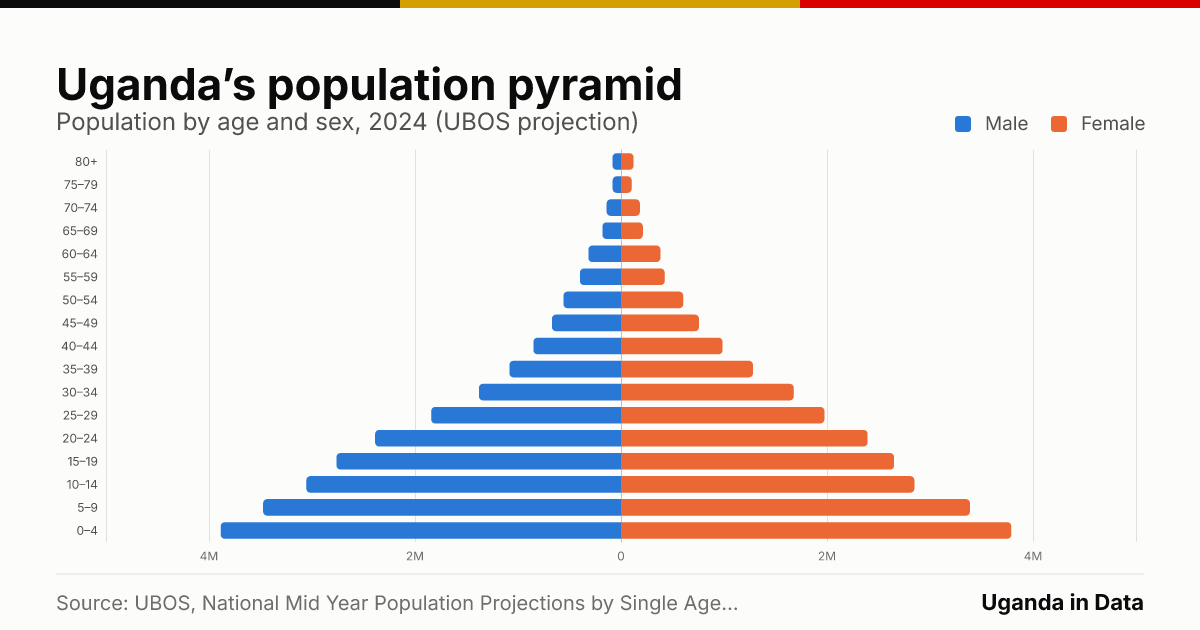 Uganda’s population pyramidHalf of Ugandans are younger than 18. For every 100 people of working age (15–64) there are 85 children and older people to support.
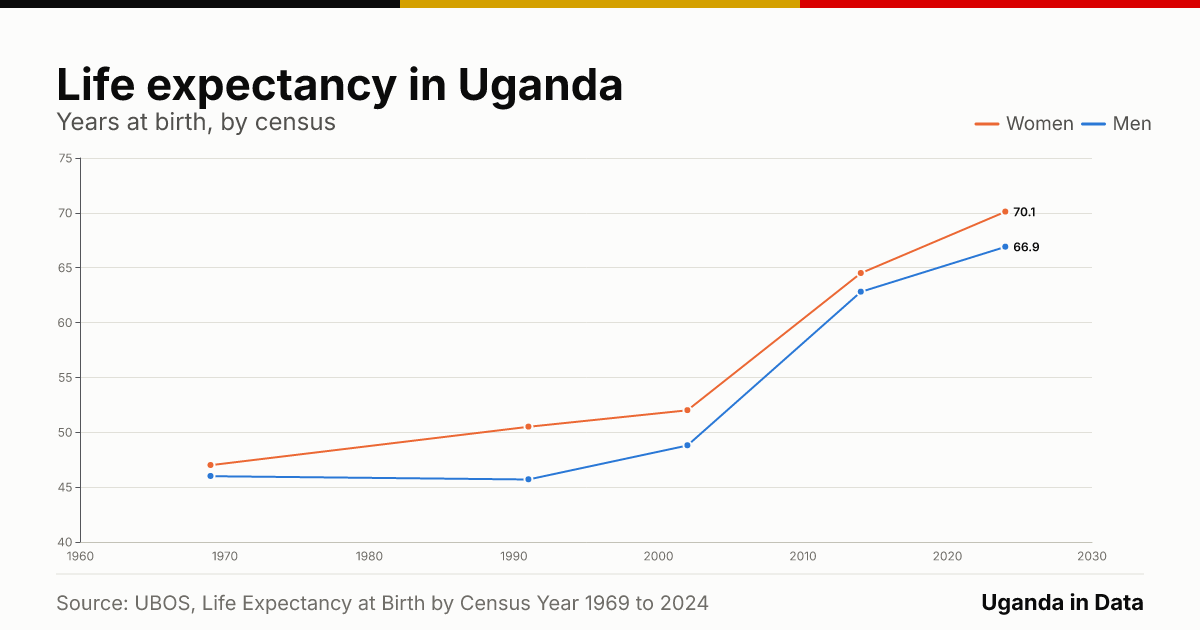 Life expectancy in UgandaLife expectancy rose from 46.5 years in 1969 to 68.2 in 2024.
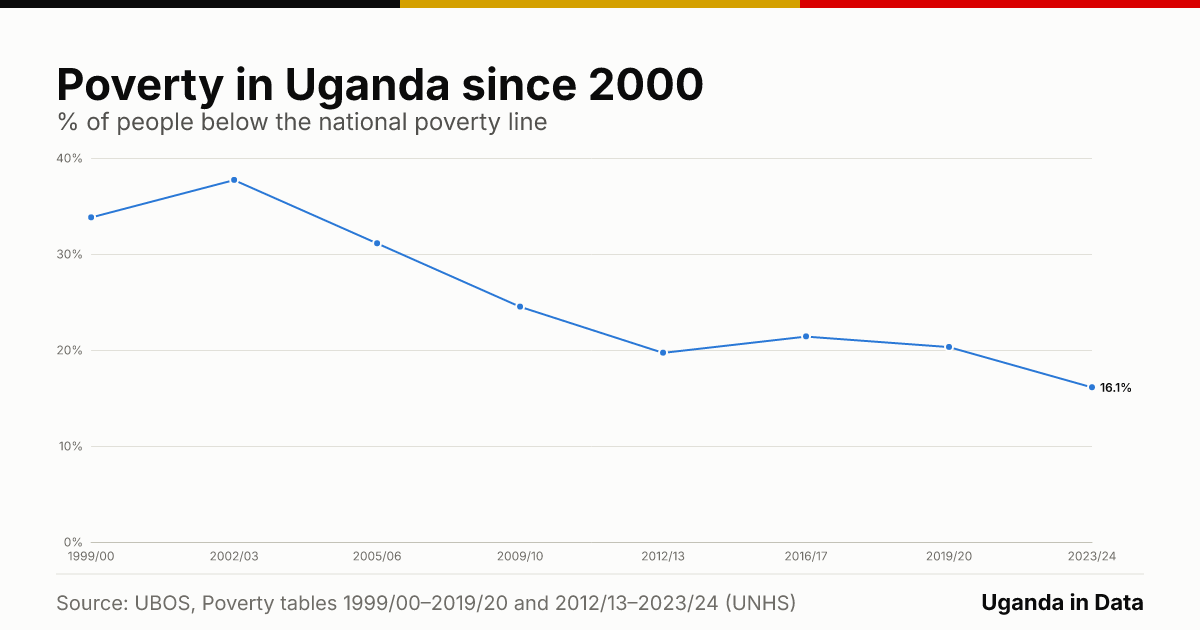 Poverty in Uganda since 200016.1% of Ugandans (7 million) were poor in 2023/24, down from 33.8% in 1999/00.
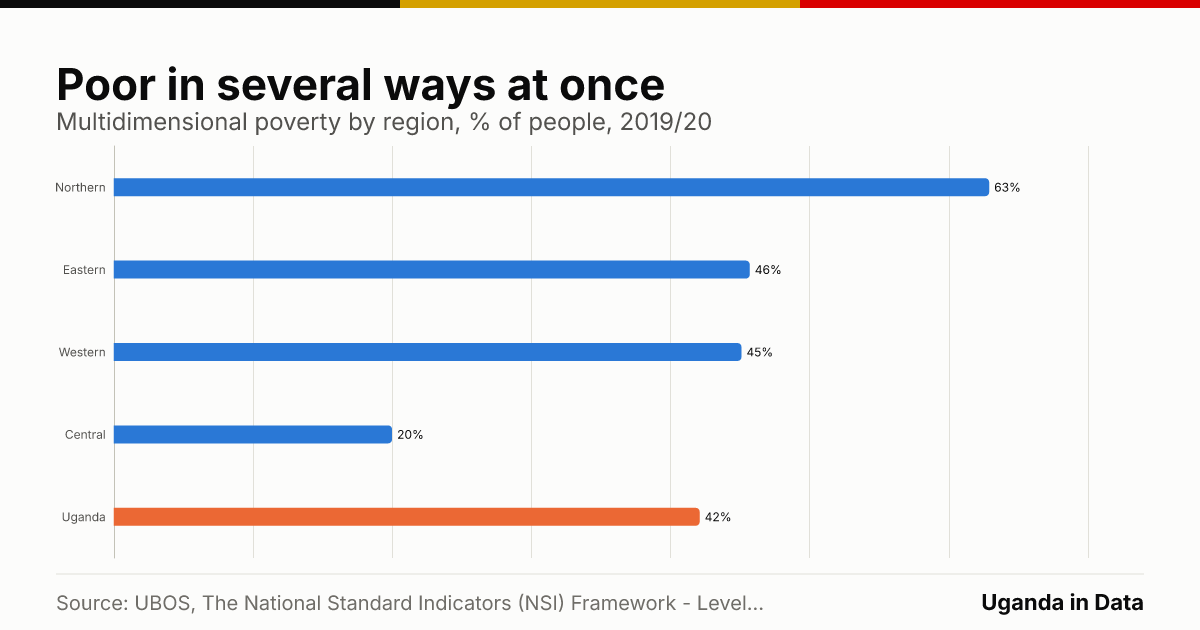
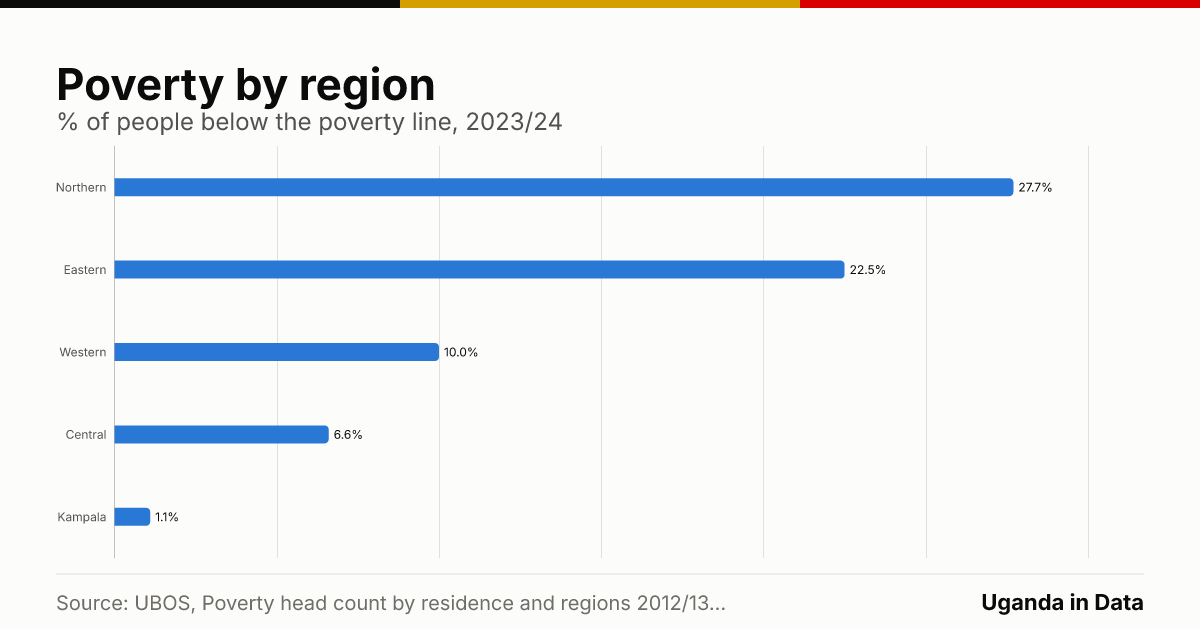 Poverty by regionNorthern is the poorest region (27.7%); Kampala the least poor (1.1%).
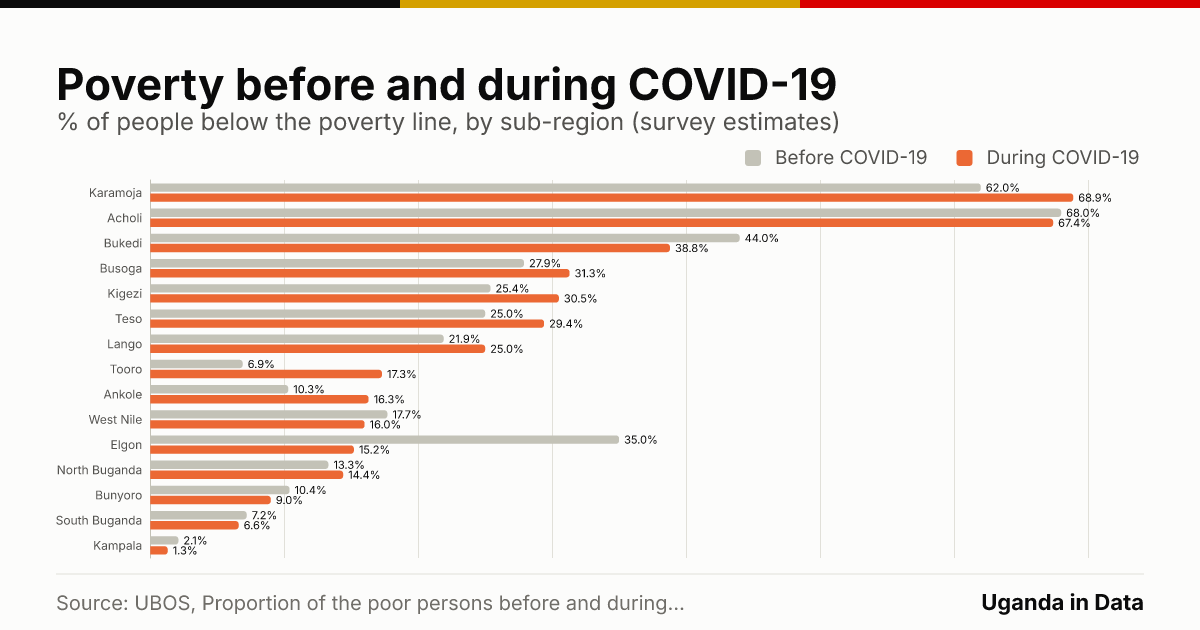 Poverty before and during COVID-19During COVID-19, poverty in rural areas rose from 20.6% to 26.9%, while in towns it barely moved (11.2% to 11.9%).
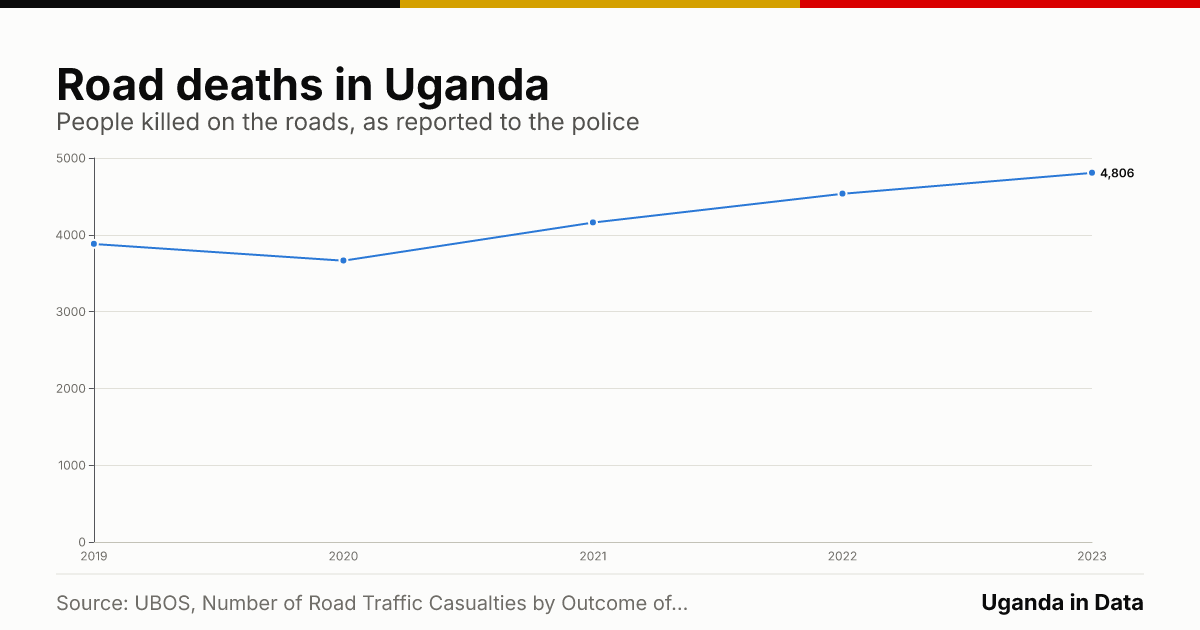 Road deaths in Uganda4,806 people were killed on Uganda’s roads in 2023, about 13 a day.
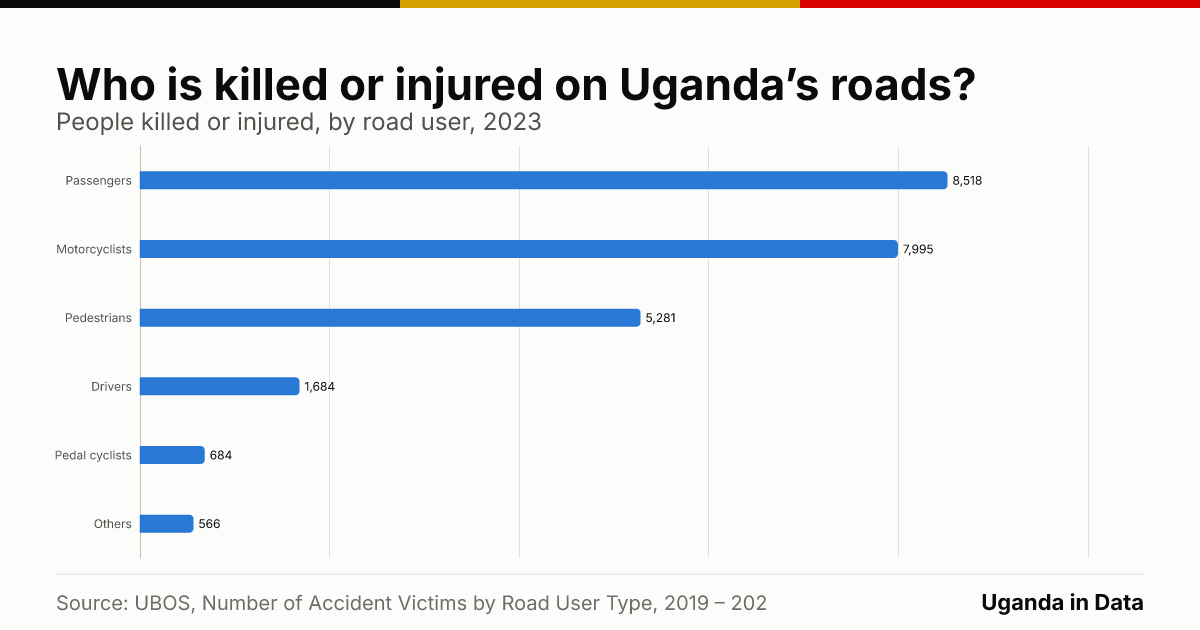 Who is killed or injured on Uganda’s roads?Passengers (8,518) and motorcyclists (7,995) were the most affected in 2023.
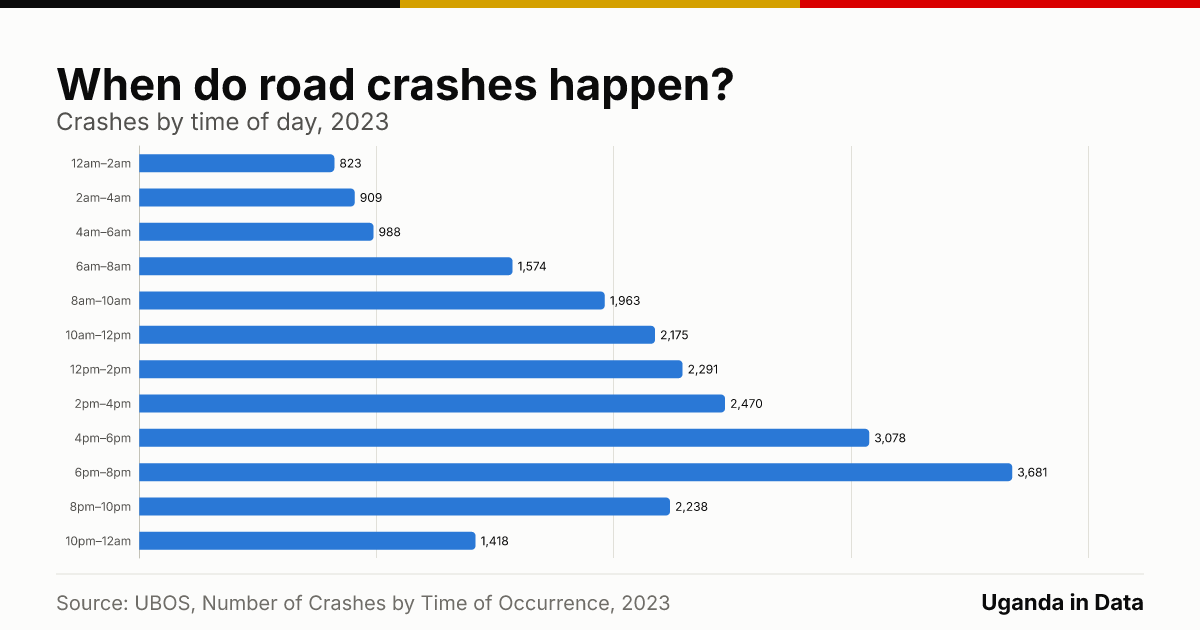 When do road crashes happen?Crashes peak at 6pm–8pm: 3,681 crashes in 2023.
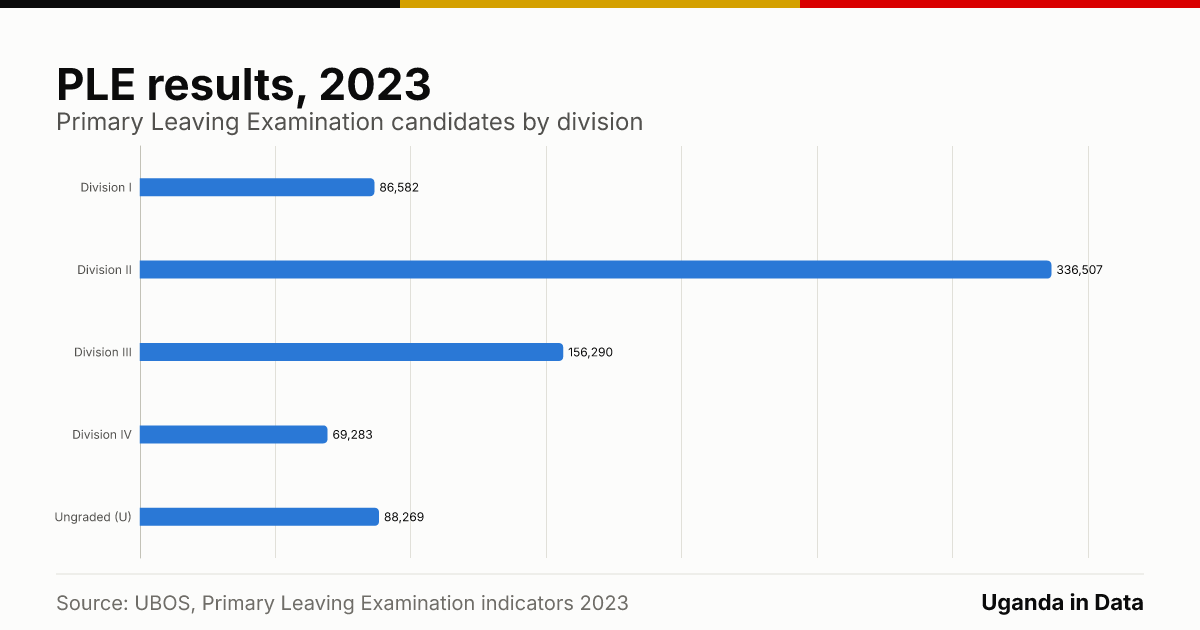 PLE results, 2023736,931 pupils sat PLE in 2023: 12% got Division I and 12% were ungraded.
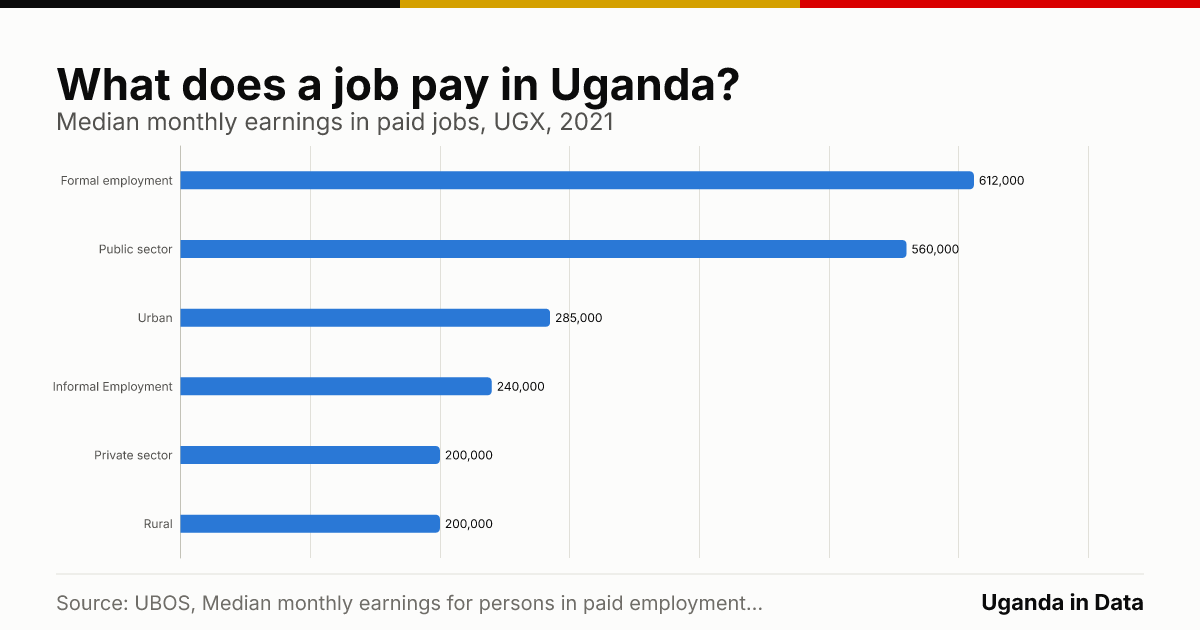 What does a job pay in Uganda?The typical worker in a paid job earned UGX 250,000 a month in 2021.
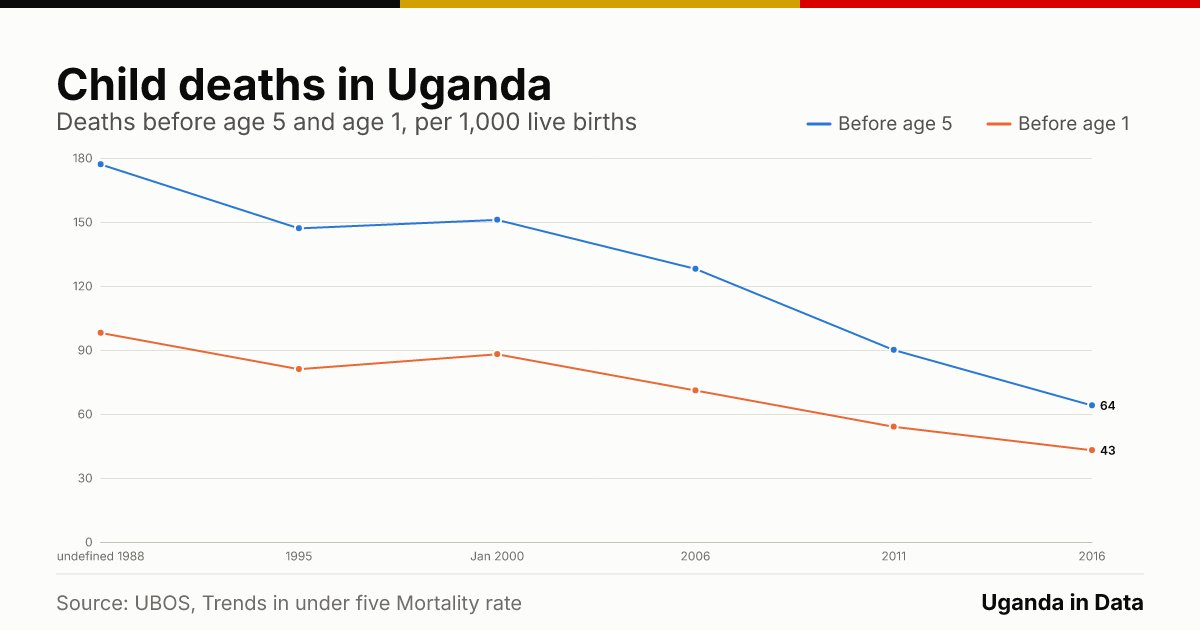 Child deaths in UgandaUnder-5 deaths fell from 177 to 64 per 1,000 births between 1988-89 and 2016.
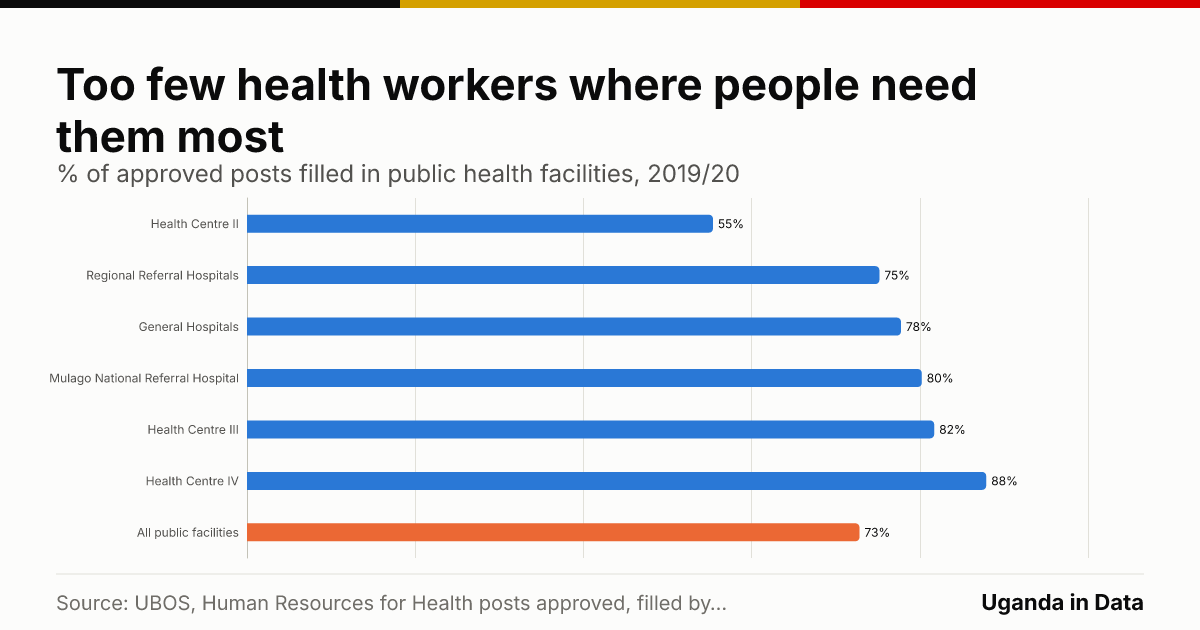 Too few health workers where people need them mostOnly 73% of approved health-worker posts in public facilities were filled in 2019/20: 17,931 posts were empty. Health Centre II clinics, often the nearest to home, had just 55% of their posts filled in 2019/20.
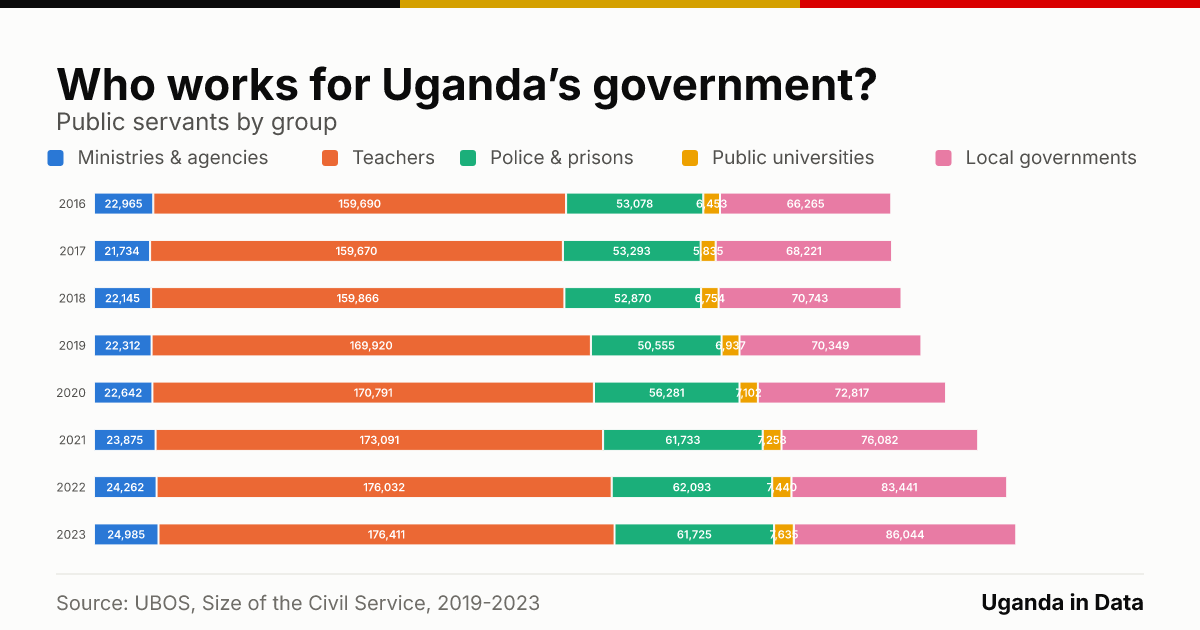 Who works for Uganda’s government?Uganda’s public service had 356,800 employees in 2023, up from 308,451 in 2016. 49% are teachers. The public-service wage bill was about UGX 411 billion a month in 2023, up from UGX 276 billion in 2020.
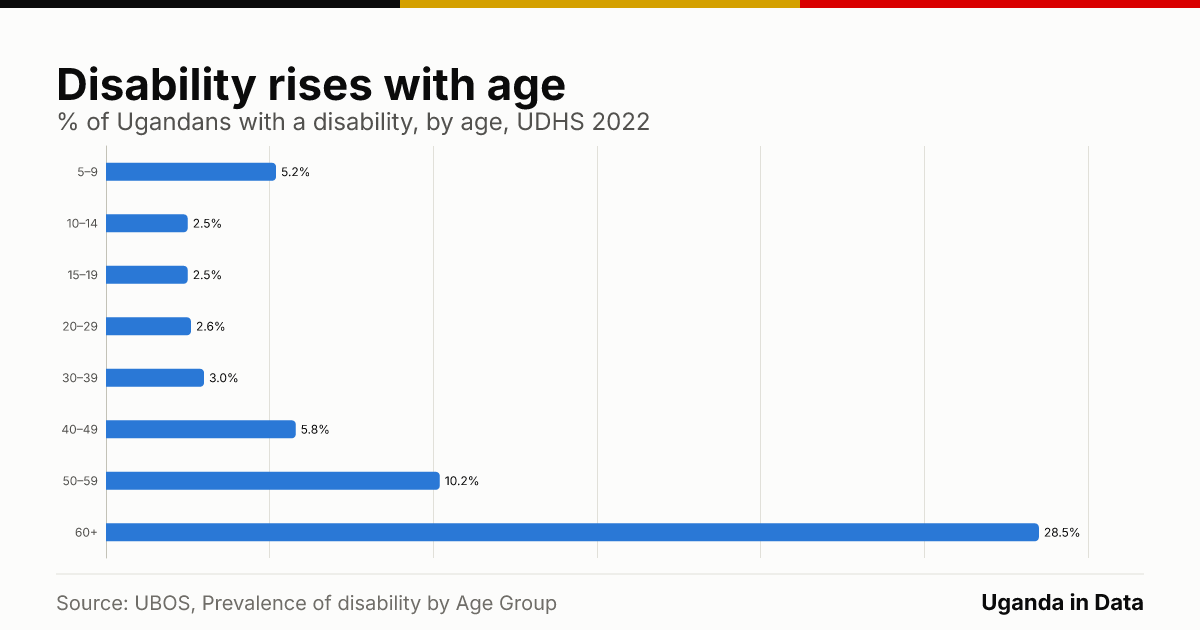 Disability rises with ageAbout 5.7% of Ugandans aged 5 and over live with a disability: a lot of difficulty, or being unable, to see, hear, walk, remember, care for themselves or communicate (UDHS 2022). Disability rises steeply with age: 28.5% of people aged 60+ have one.
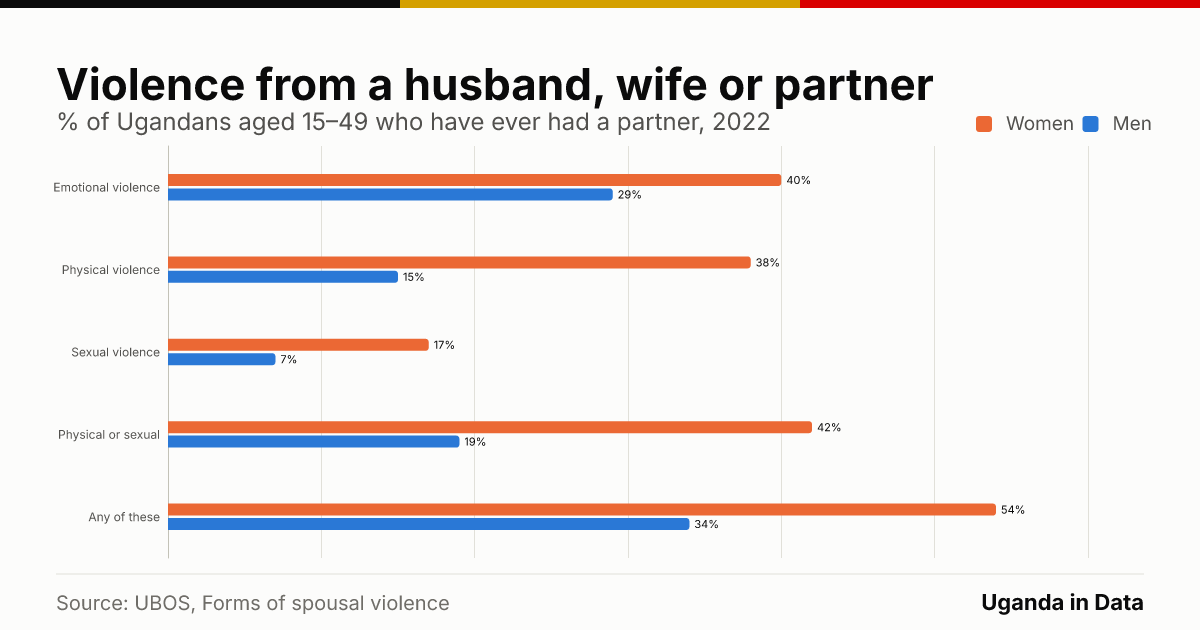 Violence from a husband, wife or partner54% of women who have ever had a partner have experienced physical, sexual or emotional violence from them, and 34% of men (2022). 38% of these women experienced physical violence from a partner, against 15% of men.
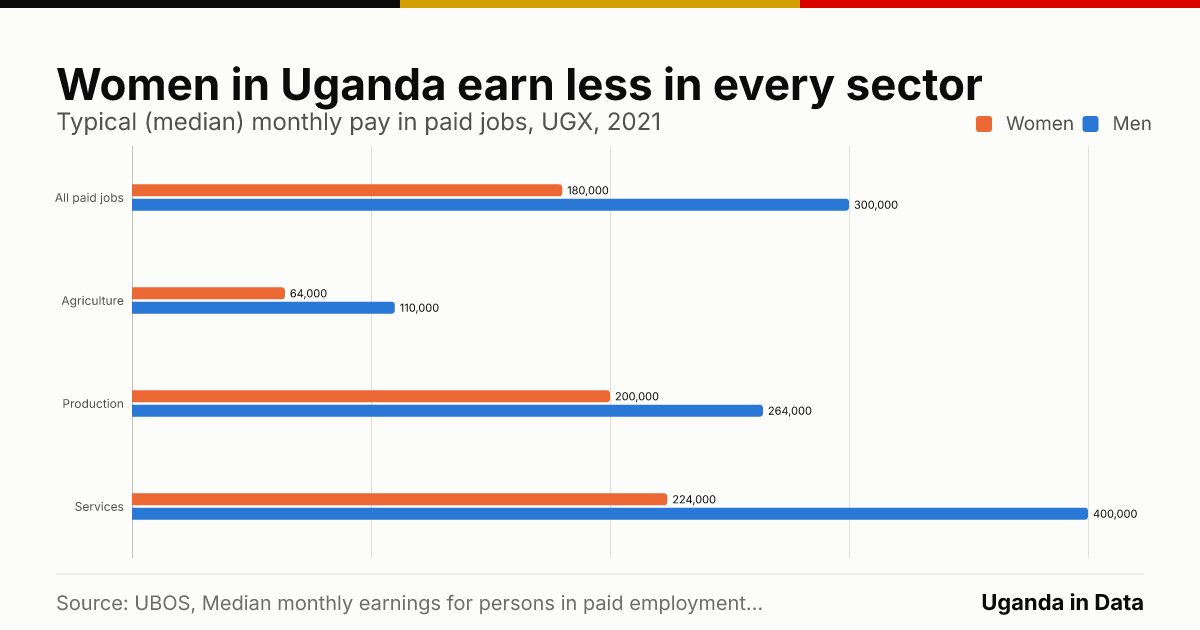 Women in Uganda earn less in every sectorThe typical woman in paid work earned UGX 180,000 a month in 2021, against UGX 300,000 for a man: 60 shillings for every 100 a man earns.
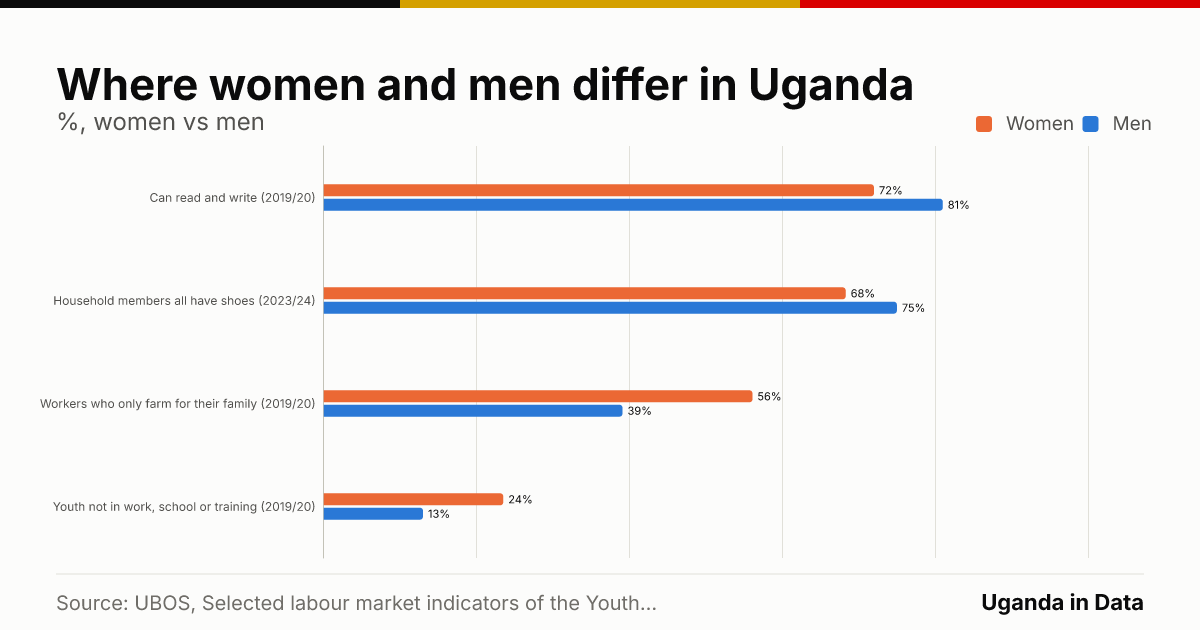 Where women and men differ in UgandaIn the 2019/20 household survey, 23.5% of young women aged 18–30 were not in work, school or training, against 13% of young men. 72% of women can read and write, against 81% of men (2019/20).
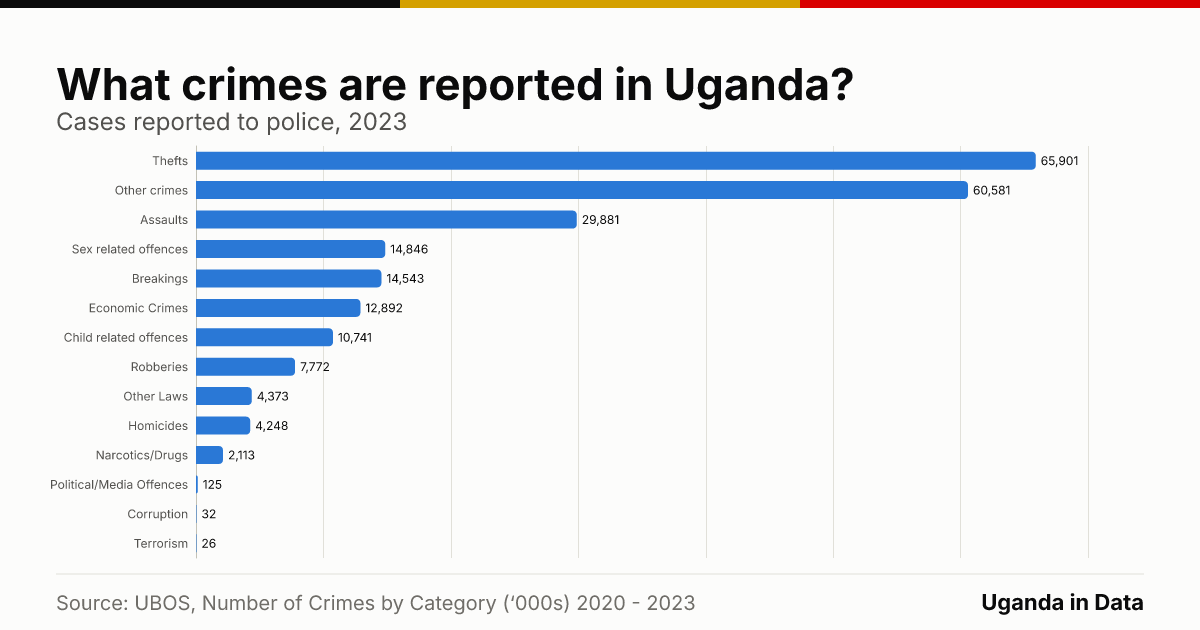 What crimes are reported in Uganda?Police recorded 228,074 crimes in 2023, up from 195,931 in 2020. 84,907 cases were taken to court that year, equal to 37% of the number reported. Theft is the most reported crime: 65,901 cases in 2023, about 181 a day.
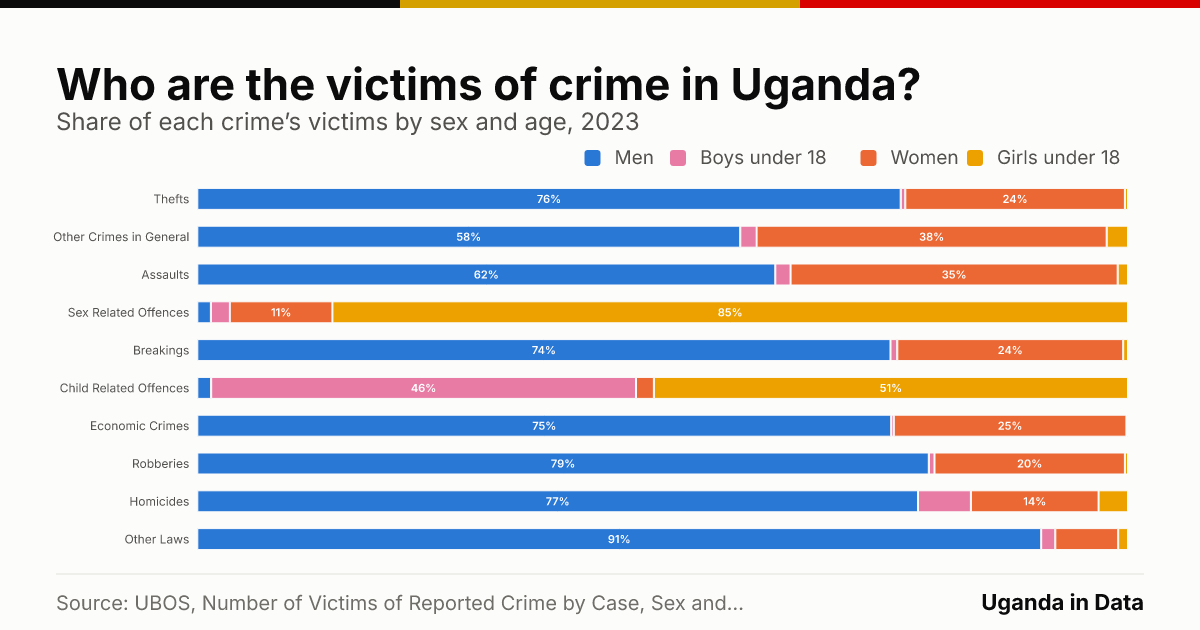 Who are the victims of crime in Uganda?Of 15,309 victims of sex-related crimes in 2023, 85% were girls under 18.
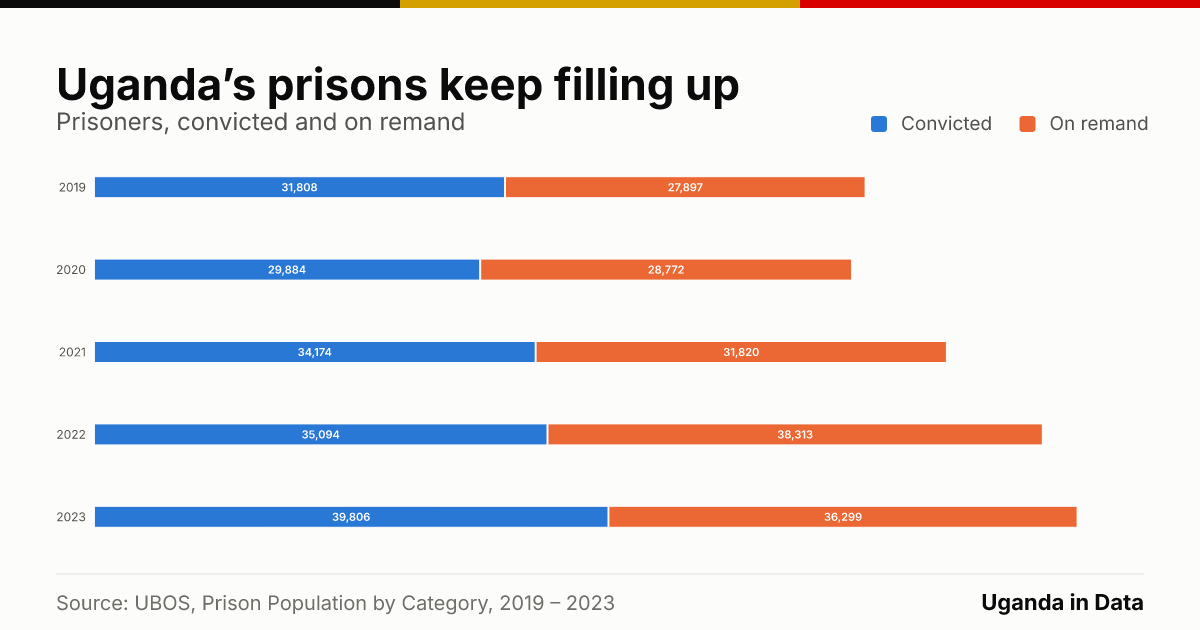 Uganda’s prisons keep filling upUganda’s prisons held 76,613 people in 2023, in space built for 20,996: 3.6 people for every place. 47% of prisoners in 2023 were on remand, waiting for trial without a conviction.
Production
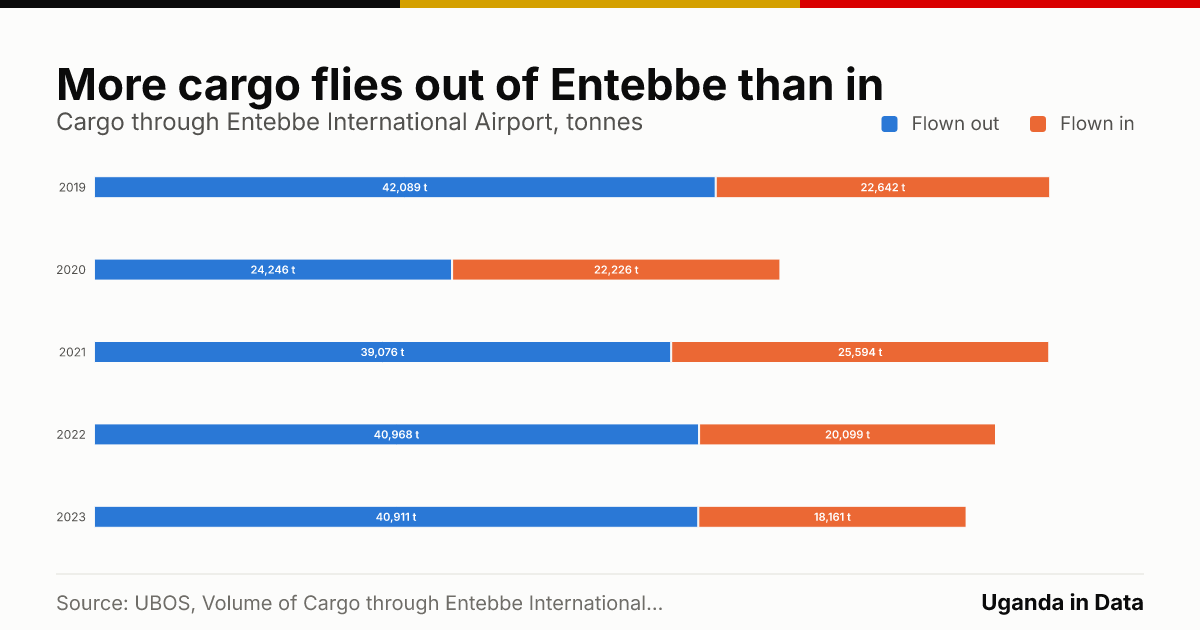 More cargo flies out of Entebbe than in40,911 tonnes of cargo were flown out of Entebbe in 2023, 2.3 times the 18,161 tonnes flown in.
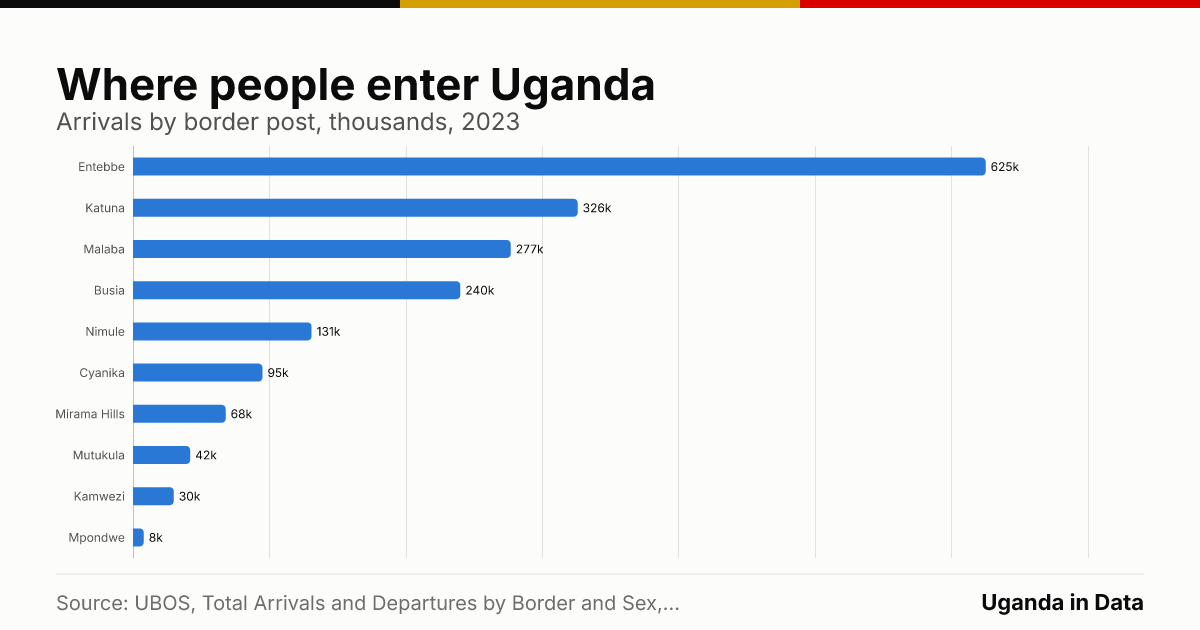 Where people enter UgandaEntebbe airport handled 34% of arrivals in 2023. The busiest road border was Katuna (326,000).
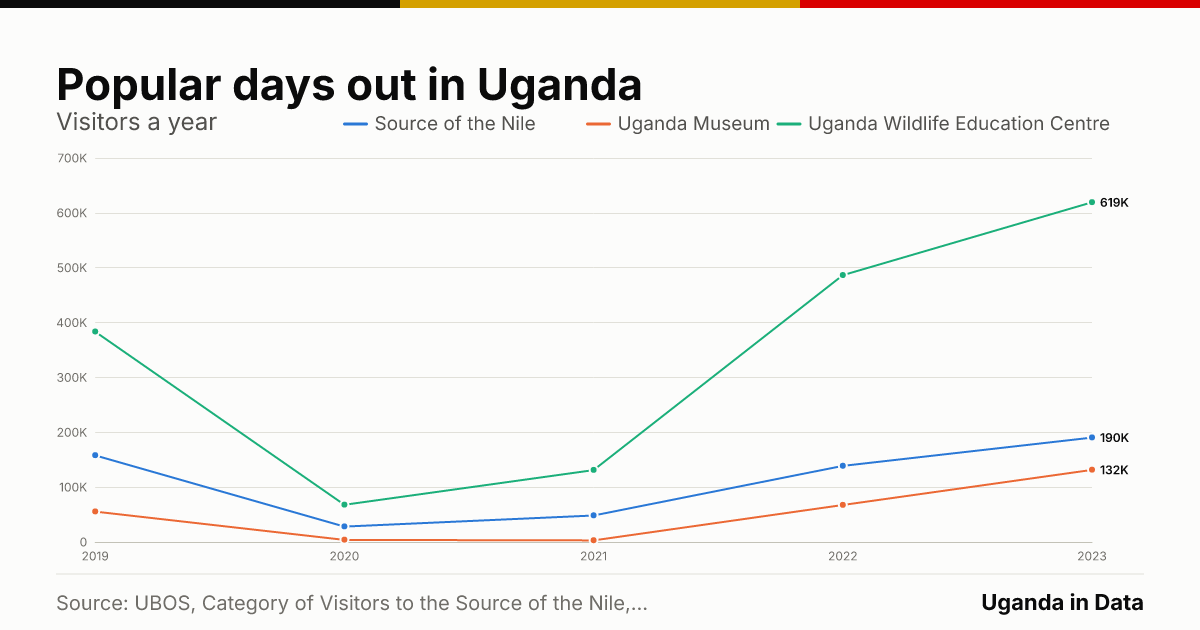 Popular days out in Uganda190,330 people visited the Source of the Nile in 2023; 65% came with school groups. The Uganda Wildlife Education Centre in Entebbe had 619,164 visitors in 2023, more than any other attraction here.
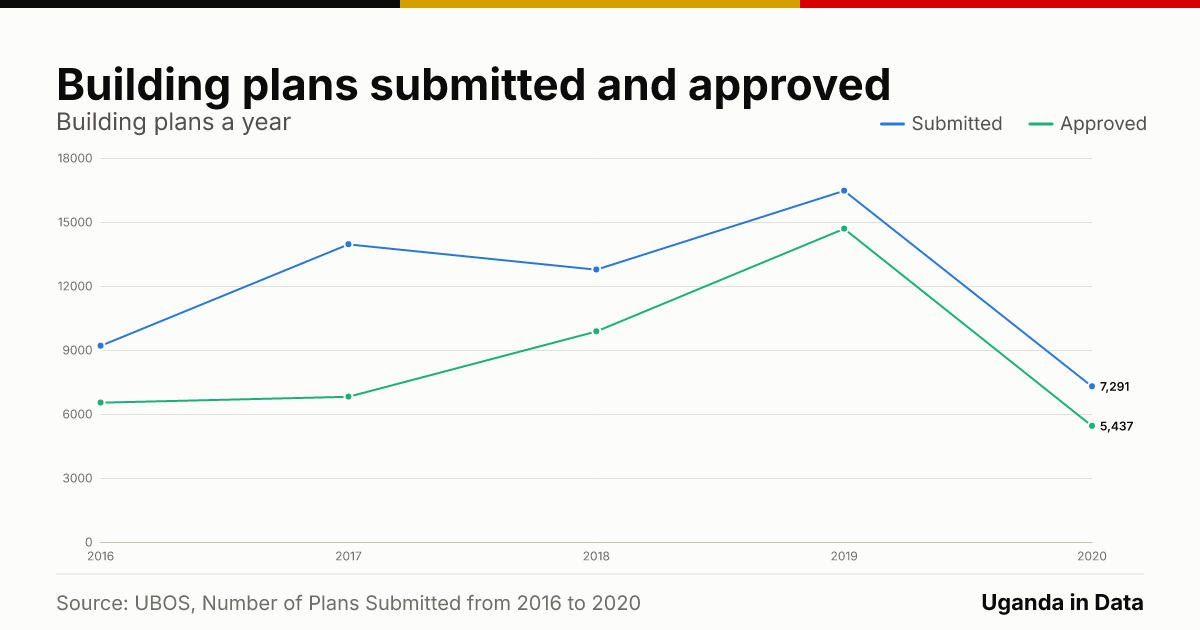 Building plans submitted and approved16,461 building plans were submitted in 2019, the most in these tables; 14,681 were approved that year.
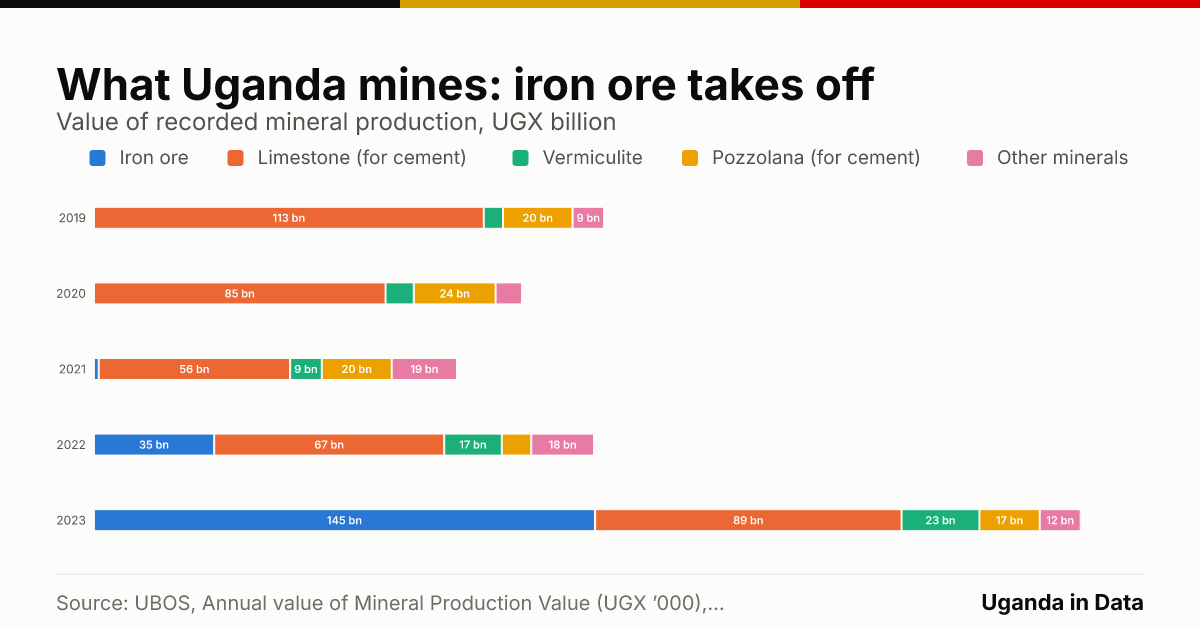 What Uganda mines: iron ore takes offRecorded mineral production was worth UGX 286 billion in 2023, up from UGX 148 billion in 2019. Iron ore went from nothing recorded before 2021 to 51% of the value of all minerals produced in 2023.
Wellbeing
Environment
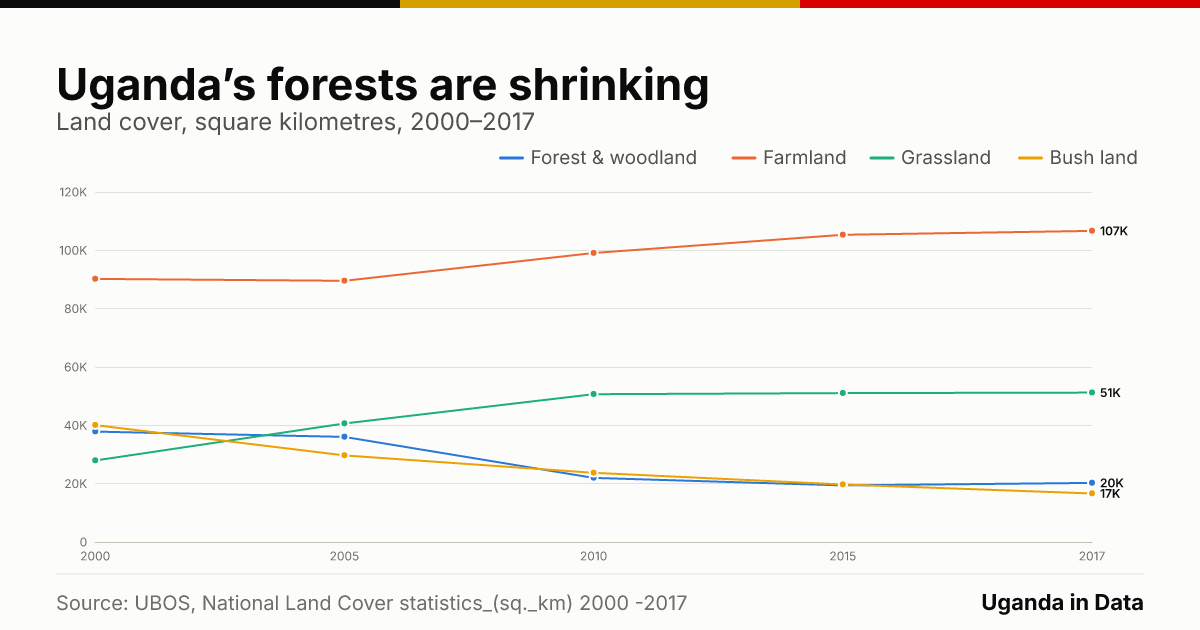 Uganda’s forests are shrinkingUganda’s forest and woodland shrank from 37,866 km² in 2000 to 20,255 km² in 2017, a loss of 47%. Farmland covered 44% of Uganda’s total area in 2017, up from 37% in 2000.
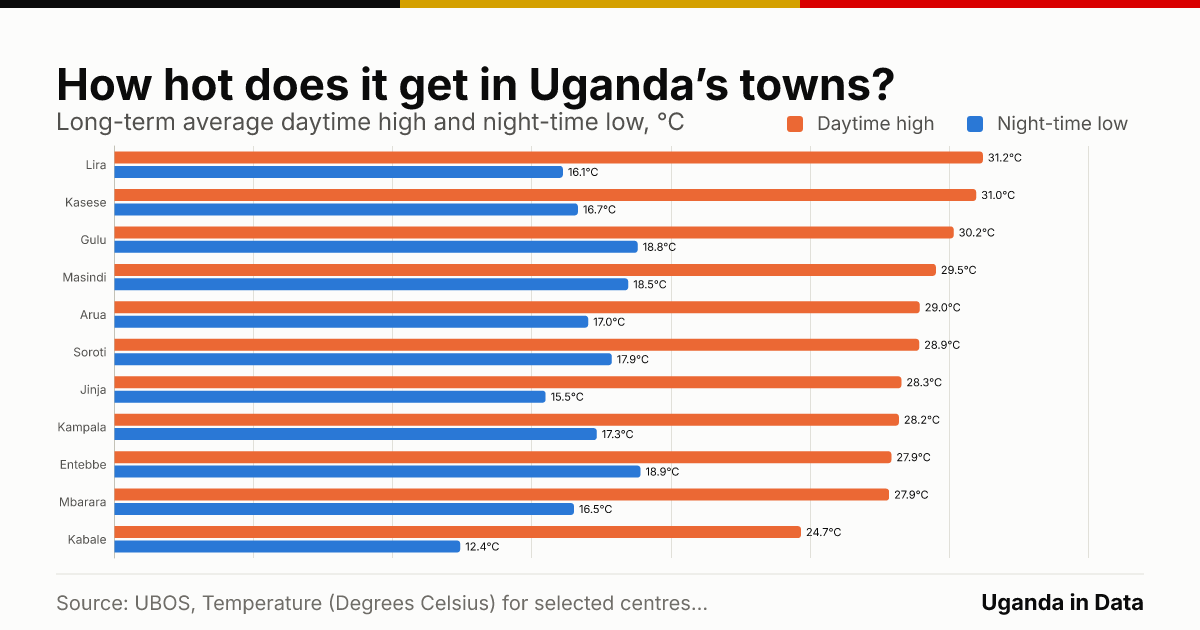 How hot does it get in Uganda’s towns?Lira is the hottest of UBOS’s weather stations: daytime highs average 31.2°C and reach 34.2°C in February. Kabale is the coolest: nights average 12.4°C.
Places
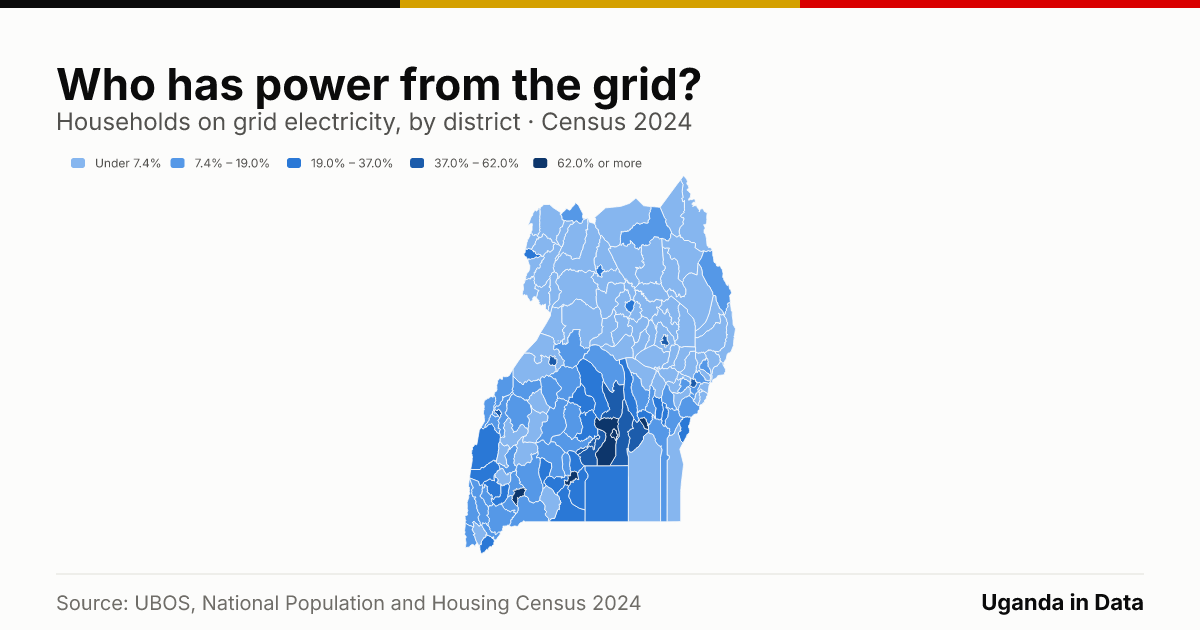 Who has power from the grid?Share of households using grid electricity for lighting. Uganda overall: 25.3%. Highest: Kampala (90.9%); lowest: Obongi (0.1%).
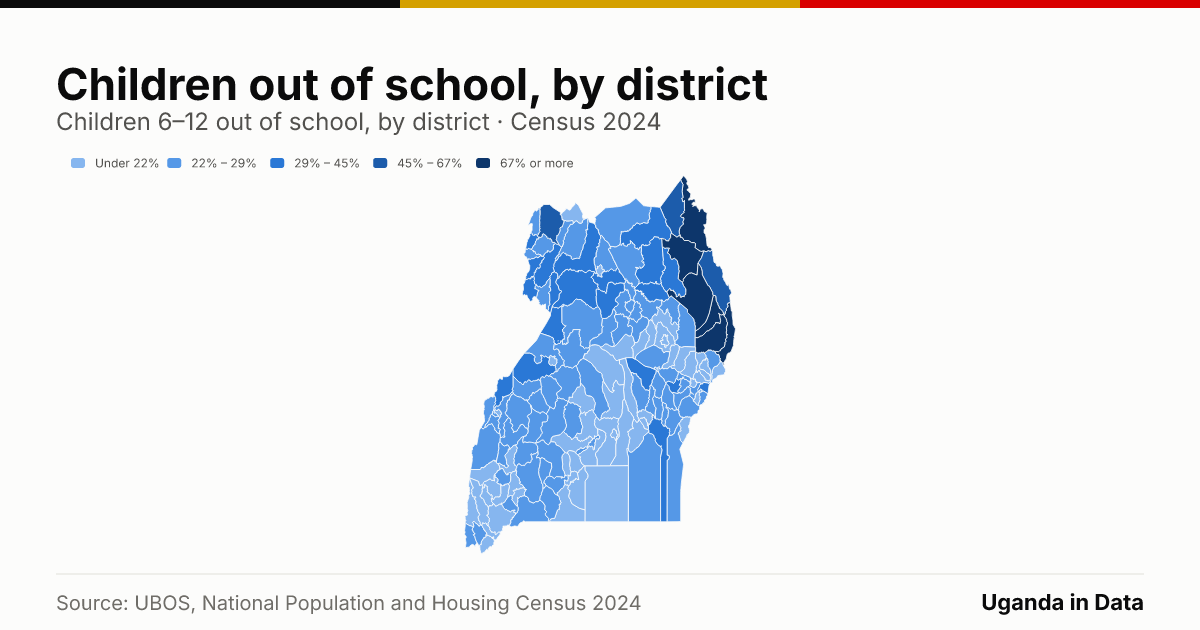 Children out of school, by districtShare of children aged 6–12 not in school. Uganda overall: 26.0%. Highest: Amudat (85.7%); lowest: Sheema (12.0%).
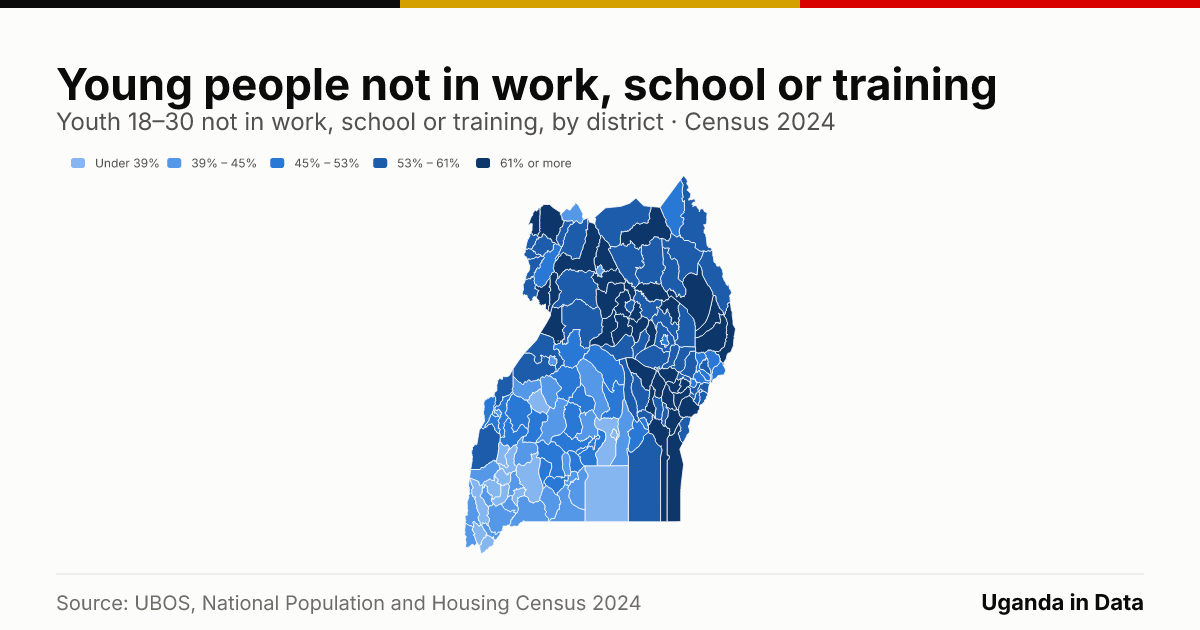 Young people not in work, school or trainingShare of 18–30 year olds not in employment, education or training. Uganda overall: 50.9%. Highest: Kwania (69.9%); lowest: Mbarara City (33.4%).